
AOD-9604 is a man-made peptide fragment that has been studied through laboratory-based research that includes peptide chemistry, molecular biology, cell signaling, and metabolic pathway studies. It is a peptide fragment that is made up of a certain region of human growth hormone (hGH). AOD-9604 is an experimental peptide used as a biological mechanism to study peptide structure and interaction with cells.
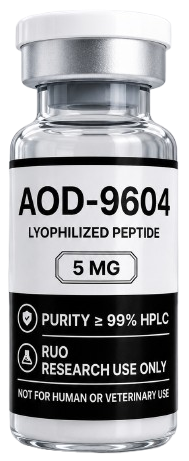
Certificate of Analysis
Batch PA-0063 — 5mg
View COA
Research Grade Quality
Independently Tested
AOD-9604
$89.99
Size / Strength
HPLC Verified
COA Included
Fast Dispatch
Discreet Shipping
100% Quality Guarantee
Every batch of AOD-9604 is independently third-party tested. 30-day money-back guarantee — no questions asked.
Product Description
Scientists study AOD-9604 to be able to analyze how modified peptides behave with the biological system differently than when proteins are used. Scientific studies focus on investigating molecular pathways, behavior of peptides and biochemical processes and not on developing any therapeutic uses of this chemical compound.
AOD-9604 5mg is only available from Peptides Australia for Research Use Only (RUO) as a laboratory chemical compound. Every batch comes with quality documents such as batch-specific analytical testing data and Certificates of Analysis (COA) which help researchers analyze the laboratory chemical compounds easily.
Research Highlights
- Independent Laboratory Tested
- Batch-Specific Certificate of Analysis
- Australia-Wide Dispatch
- Research Use Only
- HPLC Tested Peptide Material
What is AOD-9604?
AOD-9604 is a laboratory analog peptide of the fragment of human growth hormone research. The most typical description of AOD-9604 is that it is a modified analog peptide fragment of human growth hormone, which includes structural modification in the form of addition of tyrosine residue in its C-terminal end. Contrary to complete human growth hormone, AOD-9604 is a much smaller peptide fragment used in scientific studies to examine particular molecular properties.
The purposes of AOD-9604 research are:
- Structure and biological function of peptides
- Pathways of molecular signaling
- Interactions with cells
- Models for experimental metabolic research
- Biological activity of peptide fragments
Scientific Background
Human growth hormone is a highly complex protein hormone which has several biological functions. Scientists have conducted research on various parts of the hormone molecule in order to discover how particular peptide sequences play roles in biological interactions.
The development of AOD-9604 came to provide scientists with a possibility to study a more specified molecular structure than the whole molecule of the hormone.
Scientific researches conducted using AOD-9604 have focused on:
- Peptide-receptor interactions
- Molecular pathways
- Cellular research models
- Biochemical mechanisms
The substance is not registered in Australia and cannot be used therapeutically and by humans.
Peptide Classification
AOD-9604 is classified as synthetic peptide research compounds.
Features:
- Short peptide sequence
- Structure of the modified amino acids
- Synthesized in laboratory
- Used for scientific purposes
Peptide research gives scientists the opportunity to observe how biological molecules interact in the cellular processes.
Molecular Characteristics of AOD-9604
The knowledge about the molecular characteristics of AOD-9604 is important for scientists analyzing the structure and composition of peptides.
Why Researchers Investigate AOD-9604
Scientific studies of AOD-9604 have been done because this peptide offers an excellent example of a peptide model that can be used to study molecular pathways and peptide biology.
The main goal is to understand the mechanism of action rather than prove any medical benefit.
Peptide Fragment Studies
Another important area of AOD-9604 studies is understanding the possibility of independent investigation of small peptide fragments separate from large protein molecules.
This involves understanding the:
- Specifics of sequence
- Interactions at molecular level
- Behavior at structural level
- Biological pathway interaction
Cellular Signalling Research
Cells engage in communication via intricate networks, which involve proteins, peptides, receptors and various biochemcial signals.
Scientific investigations into AOD-9604 occur in cellular research models for:
- Signalling communication pathways
- Molecular interactions
- Cellular responses
- Peptide-based mechanisms
Such research advances the understanding of cellular biology.
Metabolic Pathway Research
AOD-9604 has been researched as an experimental model in metabolic research due to its connection with growth hormone fragment biology. The scientific literature contains studies regarding the molecular mechanisms involving lipid metabolic pathways, although such data is still being actively researched by scientists.
Research laboratories may explore:
- Biochemical pathways research
- Cellular metabolism models
- Molecular signalling research
- Peptide interaction research
Such research seeks to advance scientific knowledge and does not constitute evidence of any approved therapeutic application.
Molecular Biology Applications
Scientists use peptide compounds for investigating biological systems.
AOD-9604 may be studied as part of:
- In-vitro research models
- Analytical chemistry studies
- Peptide structural studies
- Molecular pathways research
Experimental laboratory research allows for studying the relationship between molecular structures and biological processes.
Experimental Research Models
The study of peptide molecules can be carried out by means of experimental investigation in which the following methods may be employed:
- Biochemistry
- Cell culture
- Molecular biology
- Analytical methods
These types of experimentations serve the purpose of obtaining knowledge on peptide chemistry.
Production and Quality
The manufacture of research peptides that will be reliable for laboratory work should be done in a controlled manner and involve the use of proper analytical techniques and documentation.
AOD-9604 5mg is a manufactured synthetic peptide for research in laboratory setting following peptide manufacturing processes.
There are many steps involved in quality-oriented peptide manufacturing. These include synthesis, purification, analytical testing and documentation review.
Solid Phase Peptide Synthesis (SPPS)
SPPS is one of the most widely used technologies in the production of synthetic peptides.
The use of SPPS technology gives researchers the ability to obtain peptides with predetermined molecular structure.
The general production procedure consists of the following steps:
- Peptide sequence preparation
- Controlled amino acid assembly
- Chemical processing and cleavage
- Purification
- Analytical testing
- Lyophilisation
- Batch documentation
Purification Process
After the synthesis step, there is purification carried out to ensure separation of the peptide compound desired from other undesired components.
Purification assists in eliminating:
- Incompletely formed peptide chains
- Other synthesis components
- Associated compounds
- Other impurities
A complete purification process contributes to enhanced analysis.
Lyophilisation Process
After purification and analysis, AOD-9604 is supplied as lyophilised powder form. The lyophilisation process entails dehydration of a substance for enhanced stability during storage. Advantages of using lyophilised research materials are:
- Minimized exposure to moisture
- Enhanced storage conditions
- Improved laboratory manipulation
- Controlled documentation
Research Use Only (RUO)
AOD-9604 5mg by Peptides Australia is made available solely for Research Use Only (RUO) laboratory usage. The peptide is made available solely for the following:
- Researching
- Analyzing in laboratories
- Educational studies
- Controlled experimentation
This peptide is not approved for clinical, diagnostics, veterinary, and human use in Australia.
Research Materials vs Medicines
Research peptides and drugs have separate uses.
Drug evaluations include:
- Safety assessments
- Clinical trials
- Production assessment
- Approval process
Research materials are used for scientific purposes and cannot be compared to pharmaceuticals.
Responsible Laboratory Research
Researchers and organizations which utilize RUO materials have the responsibility for compliance with the following:
- Policies of the institution
- Laboratory safety procedures
- Standards of research
- Australian requirements
Only laboratory conditions are acceptable for handling of AOD-9604.
Why Choose Peptides Australia?
Choosing research peptides involves having good documentation and accurate analytical information.
Peptides Australia offers research products backed by documentation meant to help:
- Lab researchers
- Universities
- Biotechnology firms
- Scientific organizations
Batch-Specific Certificate of Analysis
Batch-specific COA offers information associated with individual production batches.
This is to help with:
- Research documentation
- Material verification
- Traceability in the laboratory
Third Party Laboratory Testing
Analytical tests offer researchers information on:
- Identity of the peptide
- Purity features
- Batch consistency
HPLC tested peptides
HPLC test offers analytical data on peptide structure and purity.
Researchers can look at this documentation while evaluating lab materials.
Secure Packaging
Proper packaging helps to ensure that lyophilized peptide materials remain secure when transporting and storing them.
Australia-Wide Dispatch
Distribution helps ensure that:
- Research labs
- Universities
- Biotechnology firms
- Scientists
Researchers thinking of buying AOD-9604 in Australia should evaluate product specifications, Certificate of Analysis documents, analytical testing information, and Research Use Only category prior to selecting lab materials.
Research Use Only
This product is intended solely for laboratory research purposes. Not for human consumption.
Storage & Handling
Storage & Laboratory Handling Guidelines
Proper handling and storage practices are key elements in ensuring the quality of the peptide.
AOD-9604 is offered as a lyophilized reagent and requires proper handling in laboratory settings.
Temperature Considerations
Researchers need to think about storing the products in environments where temperatures are not unnecessarily fluctuated.
Key considerations will include:
- Ensuring optimal storage conditions
- Minimizing temperature fluctuations
- Providing protection during shipment
Moisture Protection
It is necessary to protect lyophilized reagents from moisture.
Laboratory good practices will include:
- Sealing of the containers tightly
- Minimizing exposure to high humidity
- Focusing on the manufacturer’s storage recommendations
Light Protection
Researchers need to think about protecting the peptides from prolonged exposure to light.
Optimal storage conditions ensure consistency in laboratory products.
Laboratory Records
Documentation is usually kept at scientific establishments regarding the following:
- Batch data
- Storage conditions
- Product characteristics
- Experimental methods
Correct documentation helps in quality management and responsible research.
For more details regarding laboratory peptide handling, check Peptide Storage Guidelines.
Full Technical Specifications
Every batch of AOD-9604 is independently analysed before dispatch. The values below describe the current research batch.
| Product Name | AOD-9604 |
|---|---|
| CAS Number | 221231-10-3 |
| Molecular Formula | C₇₈H₁₂₃N₂₃O₂₃S₂ |
| Molecular Weight | 1815.1 g/mol |
| Quantity / Strength | 5mg | 10mg |
| Purity | ≥ 99% (HPLC) |
| Form | Lyophilised Powder |
| Appearance | White Lyophilised Powder |
| Batch Number | PA-0063 |
| Storage Conditions | 2°C-8°C (Refrigerated) |
| Category | Metabolic Support |
| Intended Use | Research Use Only — not for human consumption |
Certificate of Analysis
Every batch of AOD-9604 is independently tested before dispatch. View the full COA for the current batch below.
Certificate of Analysis (COA)
Batch Number PA-0063
≥ 99%
Purity
HPLC
Confirmed
Identity
Mass Spec
Pass
Heavy Metals
ICP-MS
| COA Information | Purpose |
|---|---|
| Product Name | Confirms material identification |
| Batch Number | Provides traceability |
| Purity Results | Shows analytical evaluation |
| Testing Method | Identifies analytical techniques |
| Identity Testing | Supports compound confirmation |
| Quality Review | Documents assessment |
Batch Traceability and Quality Documentation
Traceability plays an essential part in responsible peptide supply for research purposes. For each batch there is documentation which enables researchers to determine:
- Product name
- Batch number
- Analytical data
- Testing methods
- Storage conditions
Maintaining batch documentation enables transparency of universities, biotechnology firms, and research laboratories.
Purity Analysis and Certificate of Analysis (COA)
Analytical analysis offers researchers critical information regarding the properties of laboratory peptide material.
Prior to purchasing research peptides, researchers often refer to analytical documentation to determine:
- Identity
- Purity
- Uniformity
- Specifications
High-Performance Liquid Chromatography (HPLC)
High-Performance Liquid Chromatography (HPLC) is one of the commonly applied analytical techniques for assessing peptide purity.
HPLC separates components of the sample and produces a chromatogram which researchers can analyze.
HPLC analysis can give information concerning:
- Purity %
- Primary peptide peak
- Associated substances
- Impurities profile
- Batch homogeneity
For peptide research labs, HPLC gives valuable analytical information on the sample composition.
LC-MS Identity Testing
Liquid Chromatography–Mass Spectrometry (LC-MS) technique is frequently applied along with HPLC for peptide identity confirmation.
Using LC-MS technique allows researchers to assess such parameters as:
- Molecular mass
- Expected identity of the compound
- Structure
Using several analytical techniques allows conducting a more thorough analysis of research peptides.
Scientists interested in analytical methods can learn more about:
- Peptide Purity
- HPLC vs LC-MS Testing
- Third-Party Lab Testing
Certificate of Analysis Overview
A Certificate of Analysis (COA) is a batch-specific report containing analytical information about a research peptide.
Typical COA may contain such elements as:
The Certificate of Analysis (COA) enables users to have an assessment of the product prior to using laboratory reagents in their scientific work.
Any researcher planning to acquire AOD-9604 in Australia needs to look at Certificates of Analysis and quality details regarding the laboratory peptides.
Research Disclaimer
For Research Use Only — Not for Human Consumption
AOD-9604 is supplied for scientific research purposes only. This information is educational and does not constitute medical advice, diagnosis, treatment guidance, or recommendations for human or veterinary use.
- Not for human or veterinary use
- No claims are made regarding safety or efficacy in humans
- Must be handled with appropriate laboratory safety equipment
- Purchaser assumes all responsibility for legal, compliant use
References
5 sources- 1Ng FM, Sun J, Sharma L, Libinaka R, Jiang WJ, Gianello R. Metabolic Studies of a Synthetic Lipolytic Domain (AOD9604) of Human Growth Hormone. Hormone Research. 2000;53(6):274-278.PubMed: https://pubmed.ncbi.nlm.nih.gov/11146367/
- 2Heffernan M, Summers RJ, Thorburn A, Ogru E, Gianello R, Jiang WJ, Ng FM. The Effects of Human GH and Its Lipolytic Fragment (AOD9604) on Lipid Metabolism Following Chronic Treatment in Obese Mice and β3-AR Knock-Out Mice. Endocrinology. 2001;142(12):5182-5189.PubMed: https://pubmed.ncbi.nlm.nih.gov/11713213/
- 3Stier H, Vos E, Kenley D. Safety and Tolerability of the Hexadecapeptide AOD9604 in Humans. Journal of Endocrinology and Metabolism. 2013;3(1-2):7-15.jofem.org: https://www.jofem.org/index.php/jofem/article/view/157/194
- 4Cox HD, Smeal SJ, Hughes CM, Cox JE, Eichner D. Detection and In Vitro Metabolism of AOD9604. Drug Testing and Analysis. 2015;7(1):31-38.PubMed: https://pubmed.ncbi.nlm.nih.gov/25208511/
- 5Australian Government, Therapeutic Goods Administration (TGA). Reasons for the Medicines Scheduling Delegate's Final Decisions, March 2015. Australian regulatory scheduling document containing the scheduling decision relevant to AOD-9604.TGA: https://www.tga.gov.au/sites/default/files/reasons-medicines-scheduling-delegates-final-decisions-march-2015.pdf
Citations are provided for research reference and open in a new tab. Listing a study does not imply it evaluated this specific product.
Frequently Asked Questions
Researchers Also Purchase
Why Researchers Choose Us
Research-Grade Quality. Trusted by Researchers Across Australia.
Learn About Our QualityDiscreet Packaging
Fast Australia-Wide Delivery
Expert Support
30-Day Money Back