
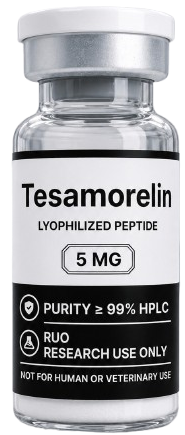
Tesamorelin is an analogue of a synthetic peptide which has recently become one of the most investigated topics in the field of growth hormone signaling pathway studies, endocrinology, and molecular signaling. Being an analogue of the growth hormone-releasing hormone (GHRH), Tesamorelin is used by researchers studying the interaction between peptide signaling pathways and pituitary hormone regulation.
Certificate of Analysis
Batch PA-0088 — 5mg
View COA
Research Grade Quality
Independently Tested
Tesamorelin
$75.99
Size / Strength
HPLC Verified
COA Included
Fast Dispatch
Discreet Shipping
100% Quality Guarantee
Every batch of Tesamorelin is independently third-party tested. 30-day money-back guarantee — no questions asked.
Tesamorelin – Research Overview
At Peptides Australia, Tesamorelin 5mg/10mg/20mg is available as a Research Use Only (RUO) peptide only for laboratory purposes and scientific research and education. It comes with comprehensive documentation for each batch in the form of information about the results of analysis and the certificate of analysis (COA).
Research Highlights
- Independent Laboratory Tested
- Batch-Specific Certificate of Analysis
- Australia-Wide Dispatch
- Research Use Only
- HPLC Tested Peptide Material
What is Tesamorelin?
Tesamorelin is a synthetic peptide analogue whose structure is designed to mimic some structural features of growth hormone-releasing hormone (GHRH). GHRH is a naturally occurring peptide hormone responsible for communication between the hypothalamus and the pituitary gland. This signalling pathway is studied because it provides an interesting case of communication by means of peptides in the endocrine system.
Tesamorelin is created using techniques of peptide engineering that help to modify the natural structure of peptides similar to GHRH. Such techniques enable scientists to study the interaction between synthetic peptides and signalling systems in an experiment.
Tesamorelin is researched in laboratory studies in relation to the following areas:
- Signalling pathways for growth hormones
- Receptor-peptide interaction
- Endocrine communication
- Hormonal regulation
- Molecular biology pathways
There has been increased scientific interest in Tesamorelin because of the general significance of the growth hormone-releasing mechanisms in scientific studies.
These scientists include universities, biotechnology groups, and life science laboratories that investigate Tesamorelin as a research compound to understand peptide signaling mechanisms better.
It is essential to differentiate between research peptides and medications. Tesamorelin offered by research peptide providers is a lab reagent used exclusively for scientific purposes.
Tesamorelin is not authorized in Australia for medical, diagnostic, and human research purposes unless authorized explicitly through regulatory channels.
Molecular Characteristics of Tesamorelin
Tesamorelin falls under the class of synthesized peptide analogs developed using advanced techniques of peptide chemistry.
The peptide is a modified amino acid sequence based on GHRH-type structures.
Stability Considerations
Similarly, to most laboratory peptides, Tesamorelin demands proper storage conditions to ensure the chemical stability. It is necessary to consider the following factors:
- Temperature conditions
- Protection from moisture
- Light exposure
- Conditions of packaging
- Transportation conditions
Learning about the stability of peptides is an essential component of laboratory management.
Moreover, researchers might consult the following sources:
- Guidelines on Storage of Peptides
- Understanding Peptide Purity
- How to Interpret a Certificate of Analysis
Why Do Researchers Study Tesamorelin?
Researchers study Tesamorelin due to the involvement of this substance into GHRH signalling pathways and communication processes. The research conducted using Tesamorelin is aimed at examining molecular interactions, not therapeutic effects.
Growth Hormone Signalling Research
Communication between various biological systems is the core of growth hormone pathways. Studying peptides such as Tesamorelin allows investigating:
- Hormone signalling pathways
- Interactions between receptors and peptides
- Biological communication pathways
- Endocrine regulation
Pituitary Signalling Research
Endocrine communications rely on the pituitary gland.
In the laboratory, investigation of GHRH related peptides includes the following areas:
- Mechanisms of hormonal signaling
- Receptor function
- Regulation
- Feedback
Through experiment, researchers can study such processes.
Peptide-Receptor Interaction Studies
A significant part of peptide studies relates to interaction of synthesized peptides with particular biological receptors.
Investigation of tesamorelin peptides may involve:
- Molecular interaction properties
- Receptor specificity
- Mechanism of signal transmission
Such studies allow scientists to find connections between peptides and biological communication.
Research of Endocrine Biology
Endocrine research is focused on communication of hormones and signaling molecules throughout the biological system.
Tesamorelin is studied in this sphere because it gives researchers the opportunity to analyze GHRH related processes.
Areas of scientific interest include:
- Hormonal regulation
- Peptides signaling
- Feedback in biology
- Molecular pathway
Cellular Signaling Studies
Cells communicate through complex signaling pathways.
Scientists study peptide molecules in order to analyze:
- Activation of signals
- Cellular responses
- Protein interactions
- Molecular pathway
Tesamorelin allows researchers to conduct experiments on peptides mediated signaling processes.
Preclinical Research Models
Tesamorelin research can involve laboratory models that have been developed to study biological mechanisms.
Such laboratory models can be based on:
- Molecular studies
- Biochemistry analysis
- Cellular research systems
- Analytical studies
The idea behind such research is to improve the knowledge about biology of peptides.
Manufacturing and Quality Assessment
In order to manufacture high-quality laboratory peptides, advanced methods should be used in combination with quality control processes.
Tesamorelin research peptides are manufactured via peptide synthesis processes that ensure consistent analytical properties of the products.
Solid Phase Peptide Synthesis (SPPS)
Peptides are typically synthesized through the process called Solid Phase Peptide Synthesis (SPPS).
This well-established technique enables researchers/manufacturers to synthesize peptides with the specific amino acid sequence.
The process of SPPS consists of several steps, including:
- Peptide sequence selection
- Amino acid assembly
- Chemical processing
- Purification
- Analytical studies
- Lyophilisation
- Batch documentation
Purification
Once peptides are synthesized, purification processes should be carried out to eliminate non-target components.
Purification assessment can involve:
- Peptide concentration
- Related components
- Impurities
- Batch consistency
Quality Control Process
In order to produce high-quality peptides, multiple steps of quality control process should be implemented, including:
- Identification
- Purity
- Documentation
- Batch traceability
Research Use Only (RUO)
Tesamorelin 5mg/10mg/20mg manufactured by Peptides Australia is solely available for Research Use Only (RUO) in laboratories. The designation "RUO" indicates that it is meant for research investigation, analytical research, and educational purposes only. This product does not receive approval in Australia for any therapeutic, diagnostic, veterinary, or human uses. Research peptides distinguish themselves from registered medicines due to the lack of regulatory evaluation necessary for approved medicinal products.
Responsible Laboratory Use
Researchers and organizations utilizing RUO products must comply with:
- Policies in institution laboratories
- Requirements of research governance
- Procedures of safety
- Relevant Australian legislation
Appropriate utilization includes scientific investigations of the peptide structure, biochemical pathway, analytical and biological properties.
Difference Between Research Materials and Medicines
Research peptides are chemicals manufactured specifically to aid scientific research. Medicines have to undergo a lot of regulatory scrutiny, which includes:
- Safety
- Quality
- Efficacy
- Manufacturing standards
- Indications
The Tesamorelin research peptide should never be considered a medicine.
Why Choose Peptides Australia?
Choosing dependable research reagents requires full transparency, analytical data, and correct information on products.
Peptides Australia assists researchers in obtaining research peptide reagents with full analytical data.
Main reasons to choose Peptides Australia:
Batch-Specific Certificates of Analysis
Batch-specific COAs help researchers check analytical data pertaining to specific batches.
Independent Laboratory Testing
Independent testing enables researchers to be confident in:
- Peptide identity
- Purity
- Consistency between batches
HPLC Tested Peptides
HPLC test helps to obtain important information about purity and analytical properties of the peptide.
Safe Packaging
Proper packaging protects lyophilised peptides from damage during shipping.
Shipping Across Australia
Proper delivery systems ensure availability of research materials for:
- Research laboratories
- Universities
- Biotech companies
- Scientific organizations
Researchers intending to buy Tesamorelin in Australia should check Certificate of Analysis documents before choosing the reagents.
Research Use Only
This product is intended solely for laboratory research purposes. Not for human consumption.
Tesamorelin – Storage & Handling
Storage & Lab Management Recommendations
Proper storage is one of the key aspects of preserving the quality of peptides. Tesamorelin is a lyophilized research peptide which needs proper lab management.
Temperature Maintenance
In order to preserve quality, researchers need to pay attention to the environment where it will be stored. Important aspects include:
- Following recommended conditions
- Avoiding unnecessary changes in the environment
- Preserving material while transporting
Moisture Preservation
In order to avoid excessive moisture contact, lyophilized peptides need to be protected. This could include:
- Keeping packaging tightly closed
- Avoiding humidity
- Keeping proper documentation
Light Protection
Consideration should be taken to ensure protection from prolonged exposure to direct light.
Transport Considerations
While being dispatched across Australia, proper packaging protects research material against:
- Environmental exposure
- Damage
- Temperature changes
- Laboratory Records
Good laboratory practices may include keeping records on:
- Batch number
- Storage conditions
- Documenting product
- Methods of research
For more details, researchers can refer to Peptide Storage Guidelines.
Tesamorelin – Technical Specifications
Every batch of Tesamorelin is independently analysed before dispatch. The values below describe the current research batch.
| Product Name | Tesamorelin |
|---|---|
| CAS Number | 218949-48-5 |
| Molecular Formula | C₂₂₁H₃₃₆N₇₂O₆₇S |
| Molecular Weight | 5135.9 g/mol |
| Quantity / Strength | 5mg | 10mg | 20mg |
| Purity | ≥ 99% (HPLC) |
| Form | Lyophilised Powder |
| Appearance | White Lyophilised Powder |
| Batch Number | PA-0088 |
| Storage Conditions | 2°C-8°C (Refrigerated) |
| Category | Metabolic Support |
| Intended Use | Research Use Only — not for human consumption |
Tesamorelin – Certificate of Analysis
Every batch of Tesamorelin is independently tested before dispatch. View the full COA for the current batch below.
Certificate of Analysis (COA)
Batch Number PA-0088
≥ 99%
Purity
HPLC
Confirmed
Identity
Mass Spec
Pass
Heavy Metals
ICP-MS
| COA Information | Purpose |
|---|---|
| Product Name | Confirms material identification |
| Batch Number | Provides traceability |
| Testing Date | Records analysis timeline |
| Purity Result | Shows analytical purity data |
| Testing Method | Identifies analytical techniques used |
| Identity Confirmation | Supports compound verification |
| Quality Review | Documents batch assessment |
Manufacturing Timeline & Batch Traceability
The production of research peptides requires controlled processes to ensure consistency, analytical reliability, and proper documentation.
A typical Tesamorelin manufacturing workflow involves several stages:
1. Peptide Design and Synthesis
First, the production process involves peptide sequence identification and synthesis planning. Special peptide chemistry methods are applied to combine the appropriate amino acids in the peptide.
2. Solid Phase Peptide Synthesis
In the process of SPPS, amino acids are added successively to form a particular peptide chain.
It enables manufacturers to obtain complex synthetic peptides with controlled structure.
3. Purification
After the synthesis of peptides, purification eliminates such undesirable components as:
- Incomplete peptide products
- Chemical contaminants
- Processing impurities
Purification is an essential stage for obtaining consistent laboratory-grade peptides.
4. Analytical Testing
Every batch of product is analyzed to establish its:
- Identification
- Purity
- Molecular properties
- Batch uniformity
Common analysis methods are:
- High-Performance Liquid Chromatography (HPLC)
- Liquid Chromatography-Mass Spectrometry (LC-MS)
5. Lyophilisation
After purification and testing, Tesamorelin is often subjected to the process of lyophilisation that results in lyophilized powder.
Freezing drying helps reduce the level of moisture and provides the possibility for controlled storage.
6. Quality Documentation
Certificate of Analysis (COA) is prepared for every batch.
Purity Testing & Certificate of Analysis (COA)
Laboratory testing should be based on accurate data on the objects under study.
Analytical testing provides important data about the identity, purity, and consistency of the research peptides such as Tesamorelin.
HPLC Testing
One of the main analytical tests which are used to check the purity of peptides is High-Performance Liquid Chromatography (HPLC).
While running HPLC analysis, the sample of the peptide is divided into several components. In this way, researchers can analyze the results of the process to estimate:
- Purity percentage
- The presence of related compounds
- Sample consistency
- Overall quality of analytical test
HPLC is widely applied in peptide research laboratories due to the rich information about sample composition it provides.
LC-MS Testing
Liquid Chromatography-Mass Spectrometry (LC-MS) is often combined with HPLC analysis to check the identity of the sample.
LC-MS analysis allows estimating:
- Molecular weight of the expected compound
- Peptide identity
- Sample consistency
HPLC and LC-MS provide complementary data about peptide samples.
Researchers can learn about these tests in more detail by using educational materials such as HPLC vs LC-MS Testing.
Understanding a Certificate of Analysis
A Certificate of Analysis (COA) is an important quality document that provides batch-specific analytical information.
A Tesamorelin COA may include:
Prior to buying lab peptides, researchers need to look through documentation in order to gain understanding of the product specifications and analytical data. Such transparency makes it possible for universities, biotech firms, and research centers to keep relevant laboratory records.
Research Disclaimer
For Research Use Only — Not for Human Consumption
This content is provided for educational, scientific and research-information purposes only. It does not provide medical advice, treatment recommendations or personal dosage instructions. Available evidence concerning Tesamorelin includes preclinical research and completed clinical investigations. The regulatory status, safety, efficacy and approved uses of authorised Tesamorelin medicines in other jurisdictions should not be attributed to unregistered or research-grade products.
- Not for human or veterinary use
- No claims are made regarding safety or efficacy in humans
- Must be handled with appropriate laboratory safety equipment
- Purchaser assumes all responsibility for legal, compliant use
References
5 sources- 1Falutz J, Allas S, Blot K, et al. A Placebo-Controlled, Dose-Ranging Study of a Growth Hormone Releasing Factor in HIV-Infected Patients with Abdominal Fat Accumulation. AIDS. 2005;19(12):1279-1287.PubMed: https://pubmed.ncbi.nlm.nih.gov/16052083/
- 2Falutz J, Mamputu JC, Potvin D, et al. Effects of Tesamorelin (TH9507), a Growth Hormone-Releasing Factor Analog, in Human Immunodeficiency Virus-Infected Patients with Excess Abdominal Fat: A Pooled Analysis of Two Multicenter, Double-Blind Placebo-Controlled Phase 3 Trials with Safety Extension Data. Journal of Clinical Endocrinology & Metabolism. 2010;95(9):4291-4304.PubMed: https://pubmed.ncbi.nlm.nih.gov/20554713/
- 3Falutz J, Potvin D, Mamputu JC, et al. Effects of Tesamorelin, a Growth Hormone-Releasing Factor, in HIV-Infected Patients with Abdominal Fat Accumulation: A Randomized Placebo-Controlled Trial with a Safety Extension. Journal of Acquired Immune Deficiency Syndromes. 2010;53(3):311-322.PubMed: https://pubmed.ncbi.nlm.nih.gov/20101189/
- 4Stanley TL, Feldpausch MN, Oh J, et al. Effect of Tesamorelin on Visceral Fat and Liver Fat in HIV-Infected Patients with Abdominal Fat Accumulation: A Randomized Clinical Trial. JAMA. 2014;312(4):380-389.PubMed: https://pubmed.ncbi.nlm.nih.gov/25038357/
- 5Australian Government, Therapeutic Goods Administration (TGA). Understanding Your Responsibilities When Importing, Compounding and Supplying Unapproved Peptide Products. Therapeutic Goods Administration. 2026.TGA: https://www.tga.gov.au/safety/safety-monitoring-and-information/safety-alerts/understanding-your-responsibilities-when-importing-compounding-and-supplying-unapproved-peptide-products
Citations are provided for research reference and open in a new tab. Listing a study does not imply it evaluated this specific product.
Tesamorelin – Frequently Asked Questions
Researchers Also Purchase
Why Researchers Choose Us
Research-Grade Quality. Trusted by Researchers Across Australia.
Learn About Our QualityDiscreet Packaging
Fast Australia-Wide Delivery
Expert Support
30-Day Money Back