
Cagrilintide is an experimental synthetic analog peptide which has gained much interest in the field of metabolic and endocrine research. Being a long acting analog of amylin, it is investigated for its effects on various biological pathways associated with the appetite control, energy balance, gastric physiology and metabolism. Cagrilintide is continuously being investigated in various preclinical and clinical studies for the understanding of these physiological processes.
Certificate of Analysis
Batch PA-0016 — 5mg
View COA
Research Grade Quality
Independently Tested
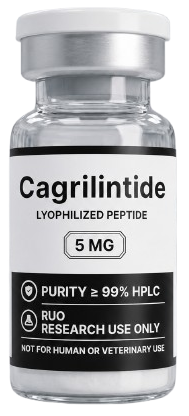
Cagrilintide
$119.99
Size / Strength
HPLC Verified
COA Included
Fast Dispatch
Discreet Shipping
100% Quality Guarantee
Every batch of Cagrilintide is independently third-party tested. 30-day money-back guarantee — no questions asked.
Cagrilintide – Research Overview
The Cagrilintide 5mg/10mg from Peptides Australia is provided as Research Use Only (RUO) grade product which can be used for scientific and analytical studies and education purposes. Each batch of the product is tested thoroughly and is accompanied by analytical information per batch.
Research Highlights
- Independent Laboratory Tested
- Batch-Specific Certificate of Analysis (COA)
- Australia-Wide Dispatch
- Research Use Only
- High Purity Laboratory Material
What is Cagrilintide?
Cagrilintide is a peptide analogue synthesized to reproduce some biological features of the natural hormone called amylin. Amylin is a natural peptide hormone that is co-secreted along with insulin from pancreatic beta cells.
Amylin functions in many different physiological pathways related to nutrition and energy management.
While amylin is the natural form of the hormone, Cagrilintide is its modified variant. The modifications were aimed at improving the molecule’s stability and biological activity in experiments. It is now widely used in research on metabolism, hormones, satiety and digestive system.
In recent times, the interest of science in the molecule of Cagrilintide has grown because of extensive research work conducted on amylin receptor agonism and signalling pathway mechanism. Scientists at laboratories, biotech companies, and academic institutes keep working on the molecular interaction studies of the compound.
In the lab settings, the use of Cagrilintide is mainly directed towards:
- Study of Amylin Receptors
- Metabolic Pathways Signalling
- Mechanism of Appetite Control
- Gastrointestinal Physiology
- Endocrine Communication
- Energy Homeostasis
- Neuroendocrine Signalling
While there have been more publications from the scientific literature, Cagrilintide still is an investigational compound that is only available for lab use.
Chemical Properties
Cagrilintide is a type of synthetic analogue peptide, synthesized via peptide engineering approach. It is synthesized through peptide synthesis and further purified before lyophilization.
Typical laboratory characteristics include:
Physical Characteristics
The peptide is supplied as a sterile lyophilised powder designed to maximise stability during transport and laboratory storage.
Lyophilization is a process that greatly decreases water levels and makes it possible to conserve the structure of peptides, as well as to handle the substance under laboratory conditions in a controlled manner.
Each batch undergoes individual testing to confirm its identity, purity, and uniformity prior to distribution.
Why Researchers Examine Cagrilintide
This substance has emerged as an important subject of study in the sphere of metabolism and endocrinology research because of the relationship between it and the amylin receptors. Modern scientific literature reviews such biological processes as:
Appetite Regulation
Scientists attempt to understand the influence of activation of amylin receptors on the signaling pathways of appetite control.
Energy Balance
Experimental studies focus on the mechanisms of maintenance of energy balance via the hormonal networks.
Gastrointestinal Physiology
Laboratory experiments concentrate on the interactions of amylin signalling and gastrointestinal physiology.
Endocrine Communication
Scientific research on the coordination of actions of peptide hormones continues.
Regulatory Pathways of Glucose
Modern scientific literature examines the relation of amylin pathways with endocrine glucose regulatory pathways but recognizes that further study will be necessary to comprehend them thoroughly.
Signalling in Central Nervous System
The neuroendocrine research is focused on the interactions between peripheral peptide hormones and particular regions of the central nervous system involved in metabolic regulation.
Combined Research
At the same time, cagrilintide is studied together with other experimental peptides to increase understanding of complementary biological mechanisms in a laboratory environment.
In these research areas, the investigators focus on better understanding of peptide signaling and not development of therapy.
Production & Quality Control
To ensure the high quality of peptides, laboratory peptides should be produced through accurate manufacturing processes based on quality control.
Solid Phase Peptide Synthesis (SPPS)
For the production of cagrilintide, Solid Phase Peptide Synthesis (SPPS) technology is used which is widely recognized as the most popular way to synthesize complex peptides.
Purification
After production, purification helps to get rid of undesirable substances and partial peptides.
Research Use Only (RUO)
The Cagrilintide produced by Peptides Australia is only indicated for Research Use Only (RUO). The indication RUO suggests that it will only be used for scientific studies and investigations. It is not approved in Australia for therapeutic, diagnostic, veterinary, or any other purposes and therefore is not to be used out of the controlled laboratory environment.
Users of RUO materials are required to meet the following criteria:
- Institutional research policies
- Laboratory safety regulations
- Applicable Australian laws
- Research ethics
RUO materials are different from the registered drugs in terms of their regulatory approval for clinical trials.
Why choose Peptides Australia
Scientific research requires laboratory materials to be reliable.
Peptides Australia is known to provide:
- Certificates of Analysis per batch
- Independent laboratory testing
- Peptides tested with HPLC
- Batch traceability
- Australia-wide delivery
- Lab packing
- Quality documentation
- Product verification
Those researchers who are thinking about purchasing the Cagrilintide in Australia should take a close look at the available Certificate of Analysis and independent laboratory testing documentation.
It helps to support laboratories, universities, biotechnological companies, and other research institutions with well-characterized investigational peptides.
Research Use Only
This product is intended solely for laboratory research purposes. Not for human consumption.
Cagrilintide – Storage & Handling
Storage & Laboratory Handling
Correct storage is an important factor that can greatly affect peptide quality.
General laboratory suggestions include:
To store according to laboratory guidelines of the institution.
To protect from high humidity.
To avoid excessive temperature variations.
To protect from direct light.
To store in labeled packaging if possible.
To note storage conditions in laboratory documentation system.
Laboratories have to follow established Good Laboratory Practice (GLP) procedures for research peptides. Transportation conditions should minimize environmental exposure as well.
Cagrilintide – Technical Specifications
Every batch of Cagrilintide is independently analysed before dispatch. The values below describe the current research batch.
| Product Name | Cagrilintide |
|---|---|
| CAS Number | 1415456-99-3 |
| Molecular Formula | C₂₃₁H₃₄₆N₆₀O₆₆S |
| Molecular Weight | 4571.3 g/mol |
| Quantity / Strength | 5mg | 10mg |
| Purity | ≥ 99% (HPLC) |
| Form | Lyophilised Powder |
| Appearance | White Lyophilised Powder |
| Batch Number | PA-0016 |
| Storage Conditions | 2°C-8°C (Refrigerated) |
| Category | Weight Loss |
| Intended Use | Research Use Only — not for human consumption |
Cagrilintide – Certificate of Analysis
Every batch of Cagrilintide is independently tested before dispatch. View the full COA for the current batch below.
Certificate of Analysis (COA)
Batch Number PA-0016
≥ 99%
Purity
HPLC
Confirmed
Identity
Mass Spec
Pass
Heavy Metals
ICP-MS
Analytical Testing
Each batch of product is subjected to multiple analytical tests, including:
- High Performance Liquid Chromatography (HPLC)
- Liquid Chromatography-Mass Spectrometry (LC-MS)
- Identity confirmation
- Purity verification
- Lyophilization
The purified peptide is freeze dried to form a stable lyophilized powder form of the product.
Batch Traceability
Each batch is assigned with a unique identifier to facilitate:
- Manufacturing records
- Lab documents
- Quality investigations
- Batch verification
- Manufacturing Process Timeline
- Peptide Design
- Solid Phase Peptide Synthesis
- Purification
- Analytical Testing
- Lyophilization
- Quality Review
- Batch Release
- Certificate of Analysis Issue
- Purity Testing & Certificate of Analysis
Good research starts with well-defined laboratory materials.
Each batch of product should be subjected to analytical testing prior to release.
High-Performance Liquid Chromatography (HPLC)
HPLC is widely used for assessment of peptide purity via separation of molecular constituents.
Scientists review HPLC to evaluate:
- Percentage of main peak
- Impurities profile
- Overall purity
LC-MS Analysis
Liquid Chromatography – Mass Spectrometry will be helpful for confirming molecular identity based on analysis of molecular weight.
The combination of HPLC and LC-MS provides complementary information about peptide quality.
Certificate of Analysis (COA)
The Certificate of Analysis in general covers:
- Product description
- Batch number
- Date of production
- Purity result
- Analytical methods used
- Storage
- Quality control
Review of analytical certificates will help scientists confirm that the products used meet their laboratory standards prior to any experiments.
Research Disclaimer
For Research Use Only — Not for Human Consumption
This content is provided for educational, scientific and research-information purposes only. It does not provide medical advice, treatment recommendations or personal dosage instructions. Available evidence concerning Cagrilintide includes preclinical research and ongoing or completed clinical investigations, and further research is needed to establish its safety and efficacy for specific uses.
- Not for human or veterinary use
- No claims are made regarding safety or efficacy in humans
- Must be handled with appropriate laboratory safety equipment
- Purchaser assumes all responsibility for legal, compliant use
References
5 sources- 1Lau DCW, Erichsen L, Francisco AM, Satylganova A, le Roux CW, McGowan B, et al. Once-Weekly Cagrilintide for Weight Management in People with Overweight and Obesity: A Multicentre, Randomised, Double-Blind, Placebo-Controlled and Active-Controlled, Dose-Finding Phase 2 Trial. The Lancet. 2021;398(10317):2160-2172.PubMed: https://pubmed.ncbi.nlm.nih.gov/34798060/
- 2Enebo LB, Berthelsen KK, Kankam M, Lund MT, Rubino DM, Satylganova A, et al. Safety, Tolerability, Pharmacokinetics, and Pharmacodynamics of Concomitant Administration of Multiple Doses of Cagrilintide with Semaglutide 2.4 mg for Weight Management: A Randomised, Controlled, Phase 1b Trial. The Lancet. 2021;397(10286):1736-1748.PubMed: https://pubmed.ncbi.nlm.nih.gov/33894838/
- 3Kruse T, Hansen JL, Dahl K, Schäffer L, Sensfuss U, Poulsen C, et al. Development of Cagrilintide, a Long-Acting Amylin Analogue. Journal of Medicinal Chemistry. 2021;64(15):11183-11194.DOI: https://doi.org/10.1021/acs.jmedchem.1c00565
- 4Garvey WT, Blüher M, Osorto Contreras CK, Davies MJ, Lehmann EW, et al. Coadministered Cagrilintide and Semaglutide in Adults with Overweight or Obesity. New England Journal of Medicine. 2025.PubMed: https://pubmed.ncbi.nlm.nih.gov/40544433/
- 5Australian Government, Therapeutic Goods Administration (TGA). Concerns Regarding the Public Health Risks Associated with Unapproved Peptide Products. Therapeutic Goods Administration. 19 June 2026.TGA: https://www.tga.gov.au/news/media-releases/concerns-regarding-public-health-risks-associated-unapproved-peptide-products
Citations are provided for research reference and open in a new tab. Listing a study does not imply it evaluated this specific product.
Cagrilintide – Frequently Asked Questions
Researchers Also Purchase
Why Researchers Choose Us
Research-Grade Quality. Trusted by Researchers Across Australia.
Learn About Our QualityDiscreet Packaging
Fast Australia-Wide Delivery
Expert Support
30-Day Money Back