
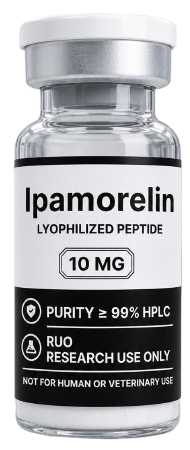
Ipamorelin is an artificial peptide that is studied in the fields of molecular biology, peptide chemistry, and cellular signaling studies. This substance is part of a group of experimental substances called growth hormone secretagogue peptides; these substances are studied to gain further knowledge about peptide-receptor interaction and biological signaling pathways.
Certificate of Analysis
Batch PA-0079 — 10mg
View COA
Research Grade Quality
Independently Tested
Ipamorelin
$85.99
Size / Strength
HPLC Verified
COA Included
Fast Dispatch
Discreet Shipping
100% Quality Guarantee
Every batch of Ipamorelin is independently third-party tested. 30-day money-back guarantee — no questions asked.
Product Description
The scientific interest in Ipamorelin is concerned with its molecular structure, interaction with certain cellular receptors, and use as a research model for the study of peptide signaling pathways. Ipamorelin is studied under controlled laboratory conditions to learn more about receptor functions and signaling pathways.
Ipamorelin 10mg from Peptides Australia is available only as a Research Use Only (RUO) laboratory substance used in scientific and analytical researches. All our products come with quality certificates, such as analytical data and batch-specific Certificates of Analysis (COA).
Research Highlights
- Independent Laboratory Tested
- Batch-Specific Certificate of Analysis
- Australia-Wide Dispatch
- Research Use Only
- HPLC Tested Peptide Material
What is Ipamorelin?
Ipamorelin is a synthetic pentapeptide comprising five amino acids. This peptide was synthesized as a research compound for the purpose of investigating its characteristics as a growth hormone secretagogue.
In contrast to natural hormones, artificial research peptides are created as molecules which are needed for scientists to study the interaction of substances.
Ipamorelin is one of those peptides that are being studied in relation to:
- Peptide receptors signaling
- Biological communications
- Molecular interactions
- Endocrinology research models
The purpose of studies with Ipamorelin is to clarify biochemical processes, not to find therapeutic applications.
Background in Science
Peptide research is significant in contemporary molecular biology, since peptides can function as signaling molecules within biological systems.
Scientists examine artificial peptides in order to learn:
- Structure interaction with the receptors
- Transmission of molecular signals
- Responses of cells to particular biochemical interaction
Ipamorelin is studied as an experimental model among others.
Growth Hormone Secretagogue Research
Ipamorelin is one of the growth hormone secretagogue research peptides.
Growth hormone secretagogues are peptides that are researched for the capability of interaction with signalling systems of growth hormone-related pathways.
The following questions are researched by scientists about growth hormone secretagogues:
- Receptor functioning
- Signalling mechanisms
- Interaction between peptides and receptors
- Regulation of molecular pathways
All this helps scientists in their studies of endocrine signalling systems.
Ghrelin Receptor Research
Another field of scientific research in relation to Ipamorelin is research of ghrelin receptor which is also referred to as growth hormone secretagogue receptor (GHS-R).
The following issues are investigated by scientists with regard to receptors:
- Molecular binding properties
- Signalling
- Cellular response
- Properties of receptors
Ipamorelin is used by scientists as an experimental peptide model to research receptor mechanisms.
Molecular Characteristics of Ipamorelin
Understanding peptide structure is an important part of laboratory research.
Ipamorelin has a defined amino acid sequence that allows researchers to analyse its chemical properties and molecular behaviour.
Stability Properties
The stability of peptides may be affected by external conditions.
The research usually involves evaluation of such factors as:
- Change in temperature
- Moisture exposure
- Exposure to light
- Packaging
- Storage period
Maintenance of adequate storage conditions helps in preserving quality of research samples.
Researchers can find additional information at related resources:
- Peptide Purity
- Peptide Storage
- Reading Certificate of Analysis
Why Researchers Study Ipamorelin
Scientific interest in Ipamorelin arises due to the fact that it is an experimental peptide used as a model to study receptor mediated signalling.
Research is based on the molecular mechanism, not the clinical results.
Peptide-Receptor Interaction Research
The role of the peptide receptor in the process of communication between cells is very significant.
Scientists conduct research in order to get more information about:
molecular recognition;
binding properties;
signaling pathways;
responses of cells.
Ipamorelin is a research material in studying these interactions in the laboratory conditions.
Cellular Signaling Research
The cellular signaling is the name for the process which allows cells to communicate using molecular signals.
Scientists carry out research on signaling pathways in order to study:
intracellular signaling;
receptors activity;
molecular regulations;
pathways interaction.
Synthetic peptides like Ipamorelin are research tools in the study of these processes.
Growth Hormone Pathway Research
Growth hormone pathways are studied by scientists in the context of endocrine biology research.
Scientists conduct laboratory research in order to study:
signal transduction mechanisms;
hormonal pathways;
receptors interaction;
molecular regulations.
Experimental Research Applications
Ipamorelin can be investigated using various laboratory methods such as:
- Molecular investigation
- Cellular study models
- Biochemical testing
- Analytical characterization
These kinds of studies are conducted in order to gain insight into peptide chemistry and biological signaling pathways.
Manufacturing and Quality Control
The manufacturing of quality research peptides needs to be carefully conducted as well as analytically confirmed and thoroughly documented.
Ipamorelin 10mg is produced as a synthetic peptide research product through standard peptide manufacturing practices.
Quality-oriented peptide manufacturing involves several steps in order to ensure:
- Peptide identification
- Consistency of peptide molecule
- Analytical properties
- Traceability of batch
This information is essential for scientists to have when evaluating laboratory peptide products.
Solid Phase Peptide Synthesis (SPPS)
Synthetic research peptides are usually manufactured through Solid Phase Peptide Synthesis (SPPS).
This is a conventional chemical synthesis technique that allows to synthesize amino acids in a certain order in order to form a certain peptide molecule.
The manufacturing process consists of the following steps:
- Peptide sequence preparation
- Amino acid coupling
- Cleavage from synthesis support material
- Purification
- Analytical testing
- Lyophilization
- Batch documentation
This approach allows scientists to obtain peptides with certain molecular properties for laboratory studies.
Purification Process
After synthesis, purification takes place in order to isolate the required peptide from other unnecessary substances.
The purpose of purification includes the separation of:
- Incomplete peptide chains
- Synthesis reagents
- Other related peptides
- Process-related impurities
The controlled process of purification ensures better analytical assessment and batch uniformity.
Ipamorelin Lyophilisation Process
Once purification and analysis have taken place, Ipamorelin will be produced in the form of lyophilized powder.
This process includes freezing and drying under certain conditions that ensure reduction of moisture content.
The advantages of lyophilised peptides include:
- Minimized moisture exposure
- Consistent storage conditions
- Convenient handling in laboratories
- Proper documentation
Appropriate laboratory protocols must be adhered to when working with lyophilised peptides.
Traceability and Quality Documentation for Batches
Batch traceability is one of the key aspects of responsible research peptide supply.
Batch documentation may include the following information:
- Identification of the product
- Batch number
- Results of analysis
- Analysis method
- Storage recommendations
This enables research institutes, universities, and laboratories to record material used in scientific research.
Research Use Only (RUO)
Ipamorelin 10mg from Peptides Australia is available only as a Research Use Only (RUO) laboratory material.
The material is exclusively designed for:
- Research purpose
- Laboratory analysis
- Educational research
- Experimentation
Ipamorelin is not approved in Australia for medical use.
Research Materials vs Approved Drugs
Research materials and drugs have different uses.
Approval of medicine includes:
- Safety evaluation
- Clinical trials
- Manufacturing
- Drug approval
Research peptides are used for scientific research and they cannot be compared to drugs.
Responsible Laboratory Research
Scientists and organizations dealing with RUO materials need to ensure their compliance with:
- Institutional needs
- Laboratory safety practices
- Research practices
- Australian law
Ipamorelin must be used in the laboratory environment only.
Why Choose Peptides Australia?
Accurate research requires clear documentation, proper supply standards, and the provision of analytical information.
Peptides Australia assists researchers in acquiring lab supplies that can be used for:
- Universities
- Biotechnological firms
- Laboratories
- Institutes
Batch-Specific Certificate of Analysis
Batch specific COAs offer analytical information associated with the product.
It facilitates:
- Laboratory Documentation
- Verification of the material
- Traceability in research
Independent Laboratory Testing
Analytical tests offer researchers information about:
- Nature of peptide
- Characteristics of purity
HPLC Tested Peptides
HPLC tests offer information about the nature of the peptide and purity.
Testing documentation is available for researchers when evaluating lab peptide materials.
Packaging
Proper packaging will assist in protecting lyophilised peptide materials while transporting and storing.
Dispatch Across Australia
Effective dispatch ensures:
- Research institutes
- Universities
- Biotech companies
- Laboratories
Researchers who are contemplating to purchase Ipamorelin in Australia need to consider product specifications, availability of Certificate of Analysis, analytical tests, and Research Use Only categorisation when selecting lab peptides.
Research Use Only
This product is intended solely for laboratory research purposes. Not for human consumption.
Storage & Handling
Storage and Handling Instructions in the Laboratory
Proper storage and handling of research materials are vital for ensuring their good quality.
Ipamorelin comes in lyophilised form and needs to be stored following appropriate laboratory instructions.
Temperature Control
Researchers need to consider storage conditions where temperature changes can be minimised.
It is essential to keep in mind:
- Storage condition compliance
- Minimal temperature change
- Proper transport
Moisture Control
Lyophilised peptides need to be protected from excess moisture.
Proper laboratory practice includes:
- Materials sealed properly
- Minimising humidity
- Supplier's instructions
Light Protection
Peptide materials need to be protected from long exposure to light.
Controlled storage conditions ensure consistency of research materials.
Laboratory Documentation
Documentation is usually kept by scientific facilities regarding:
- Batches
- Storage conditions
- Product specifications
- Experiments
Documentation helps in building up a good lab quality system.
There are various educational sources researchers may consider:
- Peptide Storage Instructions
- Certificate of Analysis Reading Guide
- Lab Quality Control
Full Technical Specifications
Every batch of Ipamorelin is independently analysed before dispatch. The values below describe the current research batch.
| Product Name | Ipamorelin |
|---|---|
| CAS Number | 170851-70-4 |
| Molecular Formula | C₃₈H₄₉N₉O₅ |
| Molecular Weight | 711.868 g/mol |
| Quantity / Strength | 10mg |
| Purity | ≥ 99% (HPLC) |
| Form | Lyophilised Powder |
| Appearance | White Lyophilised Powder |
| Batch Number | PA-0079 |
| Storage Conditions | 2°C-8°C (Refrigerated) |
| Category | Muscle Growth & Performance |
| Intended Use | Research Use Only — not for human consumption |
Certificate of Analysis
Every batch of Ipamorelin is independently tested before dispatch. View the full COA for the current batch below.
Certificate of Analysis (COA)
Batch Number PA-0079
≥ 99%
Purity
HPLC
Confirmed
Identity
Mass Spec
Pass
Heavy Metals
ICP-MS
| COA Information | Purpose |
|---|---|
| Product Name | Confirms peptide identification |
| Batch Number | Provides traceability |
| Purity Results | Shows analytical evaluation |
| Testing Method | Identifies laboratory techniques |
| Identity Testing | Supports molecular confirmation |
| Quality Review | Documents assessment |
Purity Testing & Certificate of Analysis (COA)
The analytical test data gives researchers information on identity, purity, and quality characteristics of peptides.
Pre-selection of research peptides usually involves examination of:
- Purity data
- Analytical testing data
- Identification
- Batch documents
High-Performance Liquid Chromatography (HPLC)
High-Performance Liquid Chromatography (HPLC) is a widely utilized analytical technique for assessing the purity of peptides.
HPLC separates constituents in the sample and produces a chromatographic profile that researchers analyse.
The HPLC testing could give the information on:
- Peptide purity in percentage
- Associated substances
- Composition of the sample
- Consistency of the batch
HPLC is widely utilized in laboratories dealing with peptide chemistry, biotechnology, and academic research.
Researchers who are interested in analytical techniques could look into:
- Understanding Peptide Purity
- HPLC vs LC-MS Testing
- Third-Party Laboratory Testing
LC-MS Identity Testing
Liquid Chromatography-Mass Spectrometry (LC-MS) is often used in order to confirm peptide identity.
LC-MS analysis gives the information on:
- Molecular weight
- Expected peptide identity
- Structural features
Use of various complementary analytical techniques helps researchers to better understand the characteristics of laboratory peptides.
Certificate of Analysis Explained
The Certificate of Analysis (COA) is a batch-specific document giving the information on the quality of a research peptide.
A typical COA may include:
COA provides an opportunity for researchers to examine the specifications of products prior to performing their laboratory studies.
The researchers who are considering acquiring Ipamorelin in Australia need to consult COA documents, analytical test reports, and other quality information provided by the supplier about laboratory peptides.
Research Disclaimer
For Research Use Only — Not for Human Consumption
This content is provided for educational, scientific and research-information purposes only. It does not provide medical advice, treatment recommendations or personal dosage instructions. Available evidence concerning Ipamorelin includes preclinical research and ongoing or completed clinical investigations. Further research is required to better understand its safety, pharmacology and potential efficacy for specific research applications.
- Not for human or veterinary use
- No claims are made regarding safety or efficacy in humans
- Must be handled with appropriate laboratory safety equipment
- Purchaser assumes all responsibility for legal, compliant use
References
5 sources- 1Raun K, Hansen BS, Johansen NL, et al. Ipamorelin, the First Selective Growth Hormone Secretagogue. European Journal of Endocrinology. 1998;139(5):552-561.PubMed: https://pubmed.ncbi.nlm.nih.gov/9849822/
- 2Gobburu JVS, Agersø H, Jusko WJ, Ynddal L. Pharmacokinetic-Pharmacodynamic Modeling of Ipamorelin, a Growth Hormone Releasing Peptide, in Human Volunteers. Pharmaceutical Research. 1999;16(9):1412-1416.PubMed: https://pubmed.ncbi.nlm.nih.gov/10496658/
- 3Johansen PB, Nowak J, Skjaerbaek C, Flyvbjerg A, Andreassen TT, Wilken M, Orskov H. Ipamorelin, a New Growth-Hormone-Releasing Peptide, Induces Longitudinal Bone Growth in Rats. Growth Hormone & IGF Research. 1999;9(2):106-113.PubMed: https://pubmed.ncbi.nlm.nih.gov/10373343/
- 4Raun K, von Voss P, Gotfredsen CF, Golozoubova V, Rolin B, Knudsen LB. Pharmacokinetic Evaluation of Ipamorelin and Other Peptidyl Growth Hormone Secretagogues in Rats. Xenobiotica. 1998;28(12):1173-1187.PubMed: https://pubmed.ncbi.nlm.nih.gov/9879640/
- 5Australian Government, Therapeutic Goods Administration (TGA). Reasons for Scheduling Delegate's Final Decisions: Growth Hormone Releasing Hormones, Growth Hormone Secretagogues and Growth Hormone Releasing Peptides. Therapeutic Goods Administration. March 2015.TGA: https://www.tga.gov.au/sites/default/files/reasons-medicines-scheduling-delegates-final-decisions-march-2015.pdf
Citations are provided for research reference and open in a new tab. Listing a study does not imply it evaluated this specific product.
Frequently Asked Questions
Researchers Also Purchase




Why Researchers Choose Us
Research-Grade Quality. Trusted by Researchers Across Australia.
Learn About Our QualityDiscreet Packaging
Fast Australia-Wide Delivery
Expert Support
30-Day Money Back