
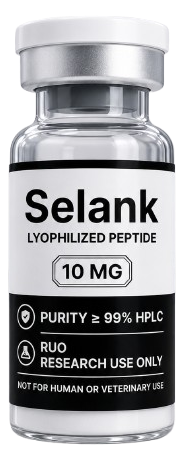
Selank is a synthetic peptide research chemical studied in molecular biology, peptide chemistry, and neuropeptide research. Scientists conduct Selank as an experimental model peptide in order to investigate the properties of peptide structures, molecular interactions, and biological signal transmission pathways within a controlled environment of laboratory studies.
Certificate of Analysis
Batch PA-0126 — 10mg
View COA
Research Grade Quality
Independently Tested
Selank
$92.99
Size / Strength
HPLC Verified
COA Included
Fast Dispatch
Discreet Shipping
100% Quality Guarantee
Every batch of Selank is independently third-party tested. 30-day money-back guarantee — no questions asked.
Product Description
Having been created as a result of research of naturally occurring peptide sequences, Selank was studied in scientific works devoted to the investigation of molecular signal transduction processes and biological processes related to peptides.
Research of Selank includes analysis, peptide chemistry, receptor interactions and signal transduction pathways. This research contributes to the development of knowledge about the possibilities of studying synthetic peptides in laboratory conditions.
At Peptides Australia, Selank 10mg is available only for Research Use Only (RUO) laboratory purposes. Each product batch comes with quality documentation, including analytical test results and batch specific Certificate of Analysis (COA).
Research Highlights
- Independent Laboratory Tested
- Batch-Specific Certificate of Analysis
- Australia-Wide Dispatch
- Research Use Only
- HPLC Tested Peptide Material
What is Selank?
Selank is a synthetic peptide used in neuropeptides research and molecular biology.
This particular peptide has been synthesized via research into tuftsin – the immunomodulating peptide fragment that exists naturally, plus some extra amino acid modifications made specifically for research purposes.
Selank is being investigated as a research peptide model for the following studies:
- Peptide structure
- Molecular interactions
- Cell communication
- Signaling pathways
Other research peptides are researched exclusively for scientific purposes, and Selank is no exception.
Scientific Background of Selank Research
Peptide science constitutes an important field of modern biotechnology and molecular research.
Peptides are studied due to the effect that their specific amino acid sequences have on:
- Three-dimensional structure
- Chemical properties
- Molecular interactions
- Biological signalling
Thus, synthetic peptide research helps to generate artificial controlled molecular models to study biological systems.
Selank can be regarded as an example of a modified synthetic peptide that is studied in the context of neuropeptide and molecular signalling research.
Tuftsin-Derived Peptide Research
The studies of selank are related to research on tuftsin-related peptide structures.
Tuftsin constitutes a natural tetrapeptide fragment that is studied in the course of biological research related to molecular communication systems.
The aim of this research is to study the following:
- Peptide modification
- Molecular structure
- Biological signalling
- Peptide molecule interaction with cellular systems
- Peptide Classification
Selank is a research compound of synthetic peptides.
Peptides constitute short chain amino acids that are joined with the help of peptide bonds.
Properties of peptides are determined by such factors as:
- Amino acid sequence
- Molecular structure
- Chemical modifications
- Environment conditions
Molecular Characteristics of Selank
Understanding molecular characteristics is an important component of peptide research.
Selank has a defined amino acid sequence that researchers evaluate through analytical techniques.
Purification Process
After the synthesis process, purification is carried out to isolate the required peptide from unnecessary components.
Purification allows eliminating:
- Incomplete peptides
- Remnants of the synthesis process
- Related peptides
- Process impurities
Proper purification process will help ensure consistency in analysis and facilitate the evaluation of characteristics of the peptide.
Lyophilisation Process
Selank is produced as a lyophilised powder after purification and analysis.
Lyophilization is a controlled freeze-drying process used for numerous laboratory peptides.
Lyophilization reduces moisture content and facilitates consistency during storage and transportation of laboratory samples.
Advantages of lyophilized research peptides include:
- Decreased moisture exposure
- Increased consistency in storage
- Better laboratory management
- Consistent documentation
It is essential to follow proper laboratory guidelines while working with lyophilized peptide material.
Batch Traceability and Quality Documentation
Batch traceability is an important element of responsible research peptide supplies.
Documentation associated with Selank includes such information as:
- Product identity
- Batch identity
- Results of analysis
- Methods of testing
- Recommendations for storage
Documentation of materials used in scientific investigation is important for universities, biotechnology companies, and research organizations.
Responsible Laboratory Research
Responsibilities include but are not limited to ensuring compliance with:
- Institutional policy
- Laboratory safety guidelines
- Standards of research conduct
- Australian regulation
Selank must be handled under laboratory conditions by trained individuals.
Why Choose Peptides Australia for Your Needs?
Effective peptide research relies on access to clear documentation, accurate information, and reliable laboratory materials.
Peptides Australia assists researchers in obtaining documentation relevant to:
- Universities
- Biotech companies
- Research laboratories
- Science institutions
- Specific Batch Certificate of Analysis
Certificates of Analysis specific for each batch offer information related to the product itself.
This is useful for:
- Laboratory documentation
- Material authentication
- Research verification
- Independent Laboratory Testing
Analytical testing offers researchers information related to:
- Peptide identification
- Purity characteristics
- Consistency within batches
- HPLC Tested Peptides
HPLC testing offers analytical information regarding peptide purity and composition.
Testing information can be reviewed by researchers for laboratory peptide materials.
Packaging
Suitable packaging assists in protecting lyophilized research material during transport and storage.
Australia-wide Dispatch
Timely dispatch assists in accessing:
- Research institutions
- Universities
- Biotech companies
- Scientific laboratories
Researchers planning to buy Selank in Australia must evaluate product specifications, Certificate of Analysis availability, analytical testing information, and Research Use Only classification.
Research Use Only
This product is intended solely for laboratory research purposes. Not for human consumption.
Storage & Handling
Moisture Protection
Lyophilized peptides should be protected against excessive moisture.
Good lab practice might include:
- Proper sealing of containers
- Avoidance of humid environments
- Observation of storage guidelines suggested by suppliers
- Protection Against Light
Scientists might think about protection of peptide reagents against excessive light exposure.
Special storage conditions allow maintaining consistency of research materials.
Laboratory Documentation
Scientific laboratories usually keep records concerning:
- Lot number
- Storage conditions
- Product specifications
- Methods of experiments
Documentation ensures proper laboratory quality management system.
Scientists may look through additional educational material:
- Guidelines on Peptide Storage
- How to Interpret a Certificate of Analysis
- Laboratory Quality Management
- Research Use Only (RUO)
Selank 10mg supplied by Peptides Australia is provided only as a Research Use Only (RUO) laboratory material.
It is intended exclusively for:
- Scientific research
- Lab testing
- Education purposes
- Experimental investigations
Selank is not approved in Australia for medical use.
Research Materials vs Approved Pharmaceuticals
There is a difference between research peptides and approved pharmaceuticals.
The procedure of approving medicines includes:
- Safety assessment
- Clinical trials
- Manufacturing process
- Approved application
Research peptides are used for scientific investigation and are not pharmaceutical materials.
Full Technical Specifications
Every batch of Selank is independently analysed before dispatch. The values below describe the current research batch.
| Product Name | Selank |
|---|---|
| CAS Number | 129954-34-3 |
| Molecular Formula | C₃₃H₅₇N₁₁O₉ |
| Molecular Weight | 751.9 g/mol |
| Quantity / Strength | 10mg |
| Purity | ≥ 99% (HPLC) |
| Form | Lyophilised Powder |
| Appearance | White Lyophilised Powder |
| Solubility | Bacteriostatic water |
| Batch Number | PA-0126 |
| Storage Conditions | 2°C-8°C (Refrigerated) |
| Shelf Life | 24 months (lyophilised, -20°C) |
| Category | Cognitive Support |
| Intended Use | Research Use Only — not for human consumption |
Certificate of Analysis
Every batch of Selank is independently tested before dispatch. View the full COA for the current batch below.
Certificate of Analysis (COA)
Batch Number PA-0126
≥ 99%
Purity
HPLC
Confirmed
Identity
Mass Spec
Pass
Heavy Metals
ICP-MS
| COA Information | Purpose |
|---|---|
| Product Name | Confirms peptide identification |
| Batch Number | Supports traceability |
| Purity Results | Provides analytical evaluation |
| Testing Method | Identifies laboratory techniques |
| Identity Testing | Supports molecular confirmation |
| Quality Review | Documents assessment |
Purity Testing & Certificate of Analysis (COA)
Analytical testing gives the information concerning the identity, purity and quality of the peptide.
Researchers usually study the following before choosing laboratory peptides:
- Purity information
- Analytical testing results
- Identity confirmation
- Batch information
- High-Performance Liquid Chromatography (HPLC)
High-Performance Liquid Chromatography (HPLC) is one of the most commonly used analytical techniques to assess peptide purity.
HPLC separates the sample constituents and produces chromatogram used for analytical evaluation.
Concerning Selank research materials, HPLC testing may give the following information:
- Purity percentage
- Composition of the sample
- Related substances
- Batch uniformity
The HPLC technique is widely used in peptide chemistry, biotechnology and academic research laboratories.
Researchers who are interested in analytical methods can learn more about:
Peptide Purity Explained
HPLC vs. LC-MS Testing
- Third Party Lab Testing
- LC-MS Identity Testing
Liquid Chromatography-Mass Spectrometry (LC-MS) is widely used to confirm peptide identity.
LC-MS analysis allows researchers to examine the following:
- Molecular weight
- Expected identity of the peptide
- Structure
The use of complementary analytical techniques gives more information about research peptides.
Certificate of Analysis Explained
A Certificate of Analysis (COA) is a batch-specific quality document containing analytical information about a research peptide.
A typical COA may include:
COA gives researchers an opportunity to check laboratory specifications on materials prior to starting scientific work.
Australian researchers planning to buy Selank would benefit from checking COA documentation, analytical data and quality requirements of the supplier before making their choice of research peptides.
Guidelines on Storage and Laboratory Handling
It is essential to pay attention to storage and handling in order to ensure good quality of research materials.
Selank is sold as a lyophilized powder and thus should be handled according to proper laboratory guidelines.
Temperature Requirements
Researchers need to pay special attention to controlled storage conditions minimizing any unnecessary temperature changes.
Key aspects of such storage include:
- Maintenance of storage conditions
- Prevention of unnecessary temperature changes
- Protection of materials in transit
Research Disclaimer
For Research Use Only — Not for Human Consumption
This content is provided for educational, scientific and research-information purposes only. It does not provide medical advice, treatment recommendations or personal dosage instructions. Available evidence concerning Selank includes preclinical research and ongoing or completed clinical investigations. Further research is required to better understand its safety, pharmacology and potential efficacy for specific research applications.
- Not for human or veterinary use
- No claims are made regarding safety or efficacy in humans
- Must be handled with appropriate laboratory safety equipment
- Purchaser assumes all responsibility for legal, compliant use
References
5 sources- 1Vyunova TV, Andreeva LA, Shevchenko KV, et al. The Molecular Aspects of Heptapeptide Selank Biological Activity. Current Protein & Peptide Science. 2018;19(6):613-621.PubMed: https://pubmed.ncbi.nlm.nih.gov/30255741/
- 2Volkova AA, Shadrina MI, Kolomin TA, et al. Selank Administration Affects the Expression of Some Genes Involved in GABAergic Neurotransmission. Frontiers in Pharmacology. 2016;7:31.PubMed Central: https://pmc.ncbi.nlm.nih.gov/articles/PMC4757669/
- 3Medvedev VE, et al. A Comparison of the Anxiolytic Effect and Tolerability of Selank and Phenazepam in the Treatment of Anxiety Disorders. Zhurnal Nevrologii i Psikhiatrii imeni S.S. Korsakova. 2014;114(7):17-22.PubMed: https://pubmed.ncbi.nlm.nih.gov/25176261/
- 4Kozlovskiy SA, Pyasik MM, Vartanov AV, et al. Functional Connectomic Approach to Studying Selank and Semax Effects. Doklady Biochemistry and Biophysics. 2020.PubMed: https://pubmed.ncbi.nlm.nih.gov/32342318/
- 5Australian Government, Therapeutic Goods Administration (TGA). TGA Warning on the Risks of Importing Unapproved Peptide Products. Therapeutic Goods Administration. 7 May 2026.TGA: https://www.tga.gov.au/safety/safety-monitoring-and-information/safety-alerts/tga-warning-risks-importing-unapproved-peptide-products
Citations are provided for research reference and open in a new tab. Listing a study does not imply it evaluated this specific product.
Frequently Asked Questions
Researchers Also Purchase

Why Researchers Choose Us
Research-Grade Quality. Trusted by Researchers Across Australia.
Learn About Our QualityDiscreet Packaging
Fast Australia-Wide Delivery
Expert Support
30-Day Money Back