
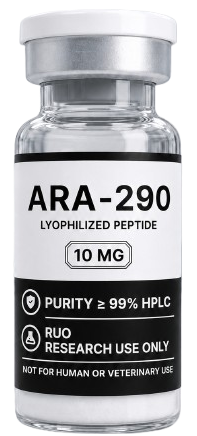
ARA-290 is a research-grade peptide studied in molecular biology, cellular signaling, and peptide chemistry. It is an experimental peptide developed from the study of Erythropoietin (EPO)-derived molecular structure and is studied by scientists interested in peptide interactions and signaling pathways.
Certificate of Analysis
Batch PA-0138 — 10mg
View COA
Research Grade Quality
Independently Tested
ARA-290
$85.99
Size / Strength
HPLC Verified
COA Included
Fast Dispatch
Discreet Shipping
100% Quality Guarantee
Every batch of ARA-290 is independently third-party tested. 30-day money-back guarantee — no questions asked.
ARA-290 – Research Overview
Laboratory research using ARA-290 centers on elucidating the molecular communications, receptor interaction and cellular processes in well-controlled laboratory settings.
Like all other research peptides, ARA-290 is a research-use investigational substance used in scientific research and not as a pharmaceutical product.
ARA-290 10mg at Peptides Australia is provided as a Research Use Only (RUO) research material only.
Research Highlights
- Independent Laboratory Testing
- Batch-Specific COA
- Nationwide Shipping
- Research Use Only
- Highly Purified HPLC Peptide Compound
What is ARA-290?
Ara-290 is a peptide research chemical that falls under the study areas of peptide science, molecular biology, and cell signaling studies.
The substance is a small peptide obtained during the study of EPO-like structures. Researchers study Ara-290 in order to further their understanding of peptide action, receptor action pathways, and molecular signaling.
While pharmaceutical drugs undergo investigation for medical purposes, research peptides are studied in laboratories to increase knowledge about biological processes.
Ara-290 is a defined molecule used in studies that include:
- Peptide structure
- Cellular signaling
- Molecular action
- Biological signaling pathways
ARA-290 research does not constitute medical use.
Scientific Background of ARA-290 Research
ARA-290 research originates from investigations into erythropoietin-related peptide structures.
Erythropoietin is a naturally occurring protein involved in complex biological signalling pathways. Researchers have examined specific peptide sequences derived from related molecular structures to understand receptor interactions and cellular communication.
ARA-290 represents an experimental peptide model used within molecular biology research.
Scientific studies involving ARA-290 focus on:
- Understanding peptide-receptor relationships
- Investigating cellular signalling mechanisms
- Evaluating molecular interactions
- Expanding knowledge of biological pathways
Peptide Classification
ARA-290 belongs to the category of synthetic peptides. Peptides are oligomers of amino acids joined together by peptide bonds. The properties of each individual peptide are determined by:
- Sequence of amino acids
- Structure of the molecule
- Properties of the chemical
- Stability of the compound
The two techniques usually used in laboratories for analysis of research peptides are:
- High Performance Liquid Chromatography (HPLC)
- Liquid Chromatography-Mass Spectrometry (LC-MS)
Erythropoietin-Derived Peptide Research Overview
Research concerning erythropoietin is well-established within molecular biology. Scientists conduct studies of erythropoietin-related processes in order to learn about:
- Protein receptor interactions
- Signalling systems in cells
- Molecular communication
ARA-290 is investigated in the context of peptide research that is related to the more general studies in science. The aim of such research is to increase knowledge of the molecular processes without applying the research for the purposes of treatment.
Molecular Properties of ARA-290
Investigation of peptide structure is a necessary part of laboratory studies. Scientists analyze ARA-290 to prove:
- Peptide identity
- Molecular composition
- Purity properties
Stability Considerations
Stability of peptides may be influenced by environmental factors. Scientists usually look at such factors as:
- Exposure to temperature
- Exposure to moisture
- Exposure to light
- Packaging environment
- Duration of storage
Appropriate storage conditions ensure preservation of research material properties. Scientists may consult additional materials on the subject:
- Peptide Purity
- Peptide Storage
- Certificate of Analysis Reading
Why Researchers Study ARA-290
Scientific studies into ARA-290 involve understanding peptide-mediated molecular signaling.
Laboratory research could include studies on:
- Receptor binding
- Cell signaling
- Peptide structure-function relationship
- Biological molecular processes
The goal of such research is to advance the science of peptides.
Cellular Signalling Research
Cellular signalling refers to the methods by which molecules interact in biological systems.
Areas of study include:
- Signal transduction
- Receptor interactions
- Responses of molecules
- Cellular signalling mechanisms
Peptide ARA-290 is used as a research model to examine signalling relations.
EPO Receptor-Related Pathway Research
Studies on ARA-290 include studies on pathways connected to erythropoietin-related molecular systems. Researchers study:
- Interactions of receptors
- Peptide signaling
- Molecular pathways
- Cellular responses
These studies are done in laboratory research environments and not for clinical uses.
Tissue Biology Research Context
Tissue biology studies study how cells talk to each other in biological systems.
Scientists study:
- Cell biology
- Molecular signalling
- Interactions in biology
- Research Models
ARA-290 helps scientists study mechanisms related to peptides in these more general areas of research.
Experimental Laboratory Uses
ARA-290 can be studied in the following ways:
- Characterization of Peptides
- Molecular Biology Studies
- Cell Signalling Studies
- Analytical Chemistry
The goal of all these studies is to gain knowledge about peptide structure and molecular pathways.
Manufacturing & Quality Standards
The generation of reliable research peptides involves the controlled method of synthesis, analysis, and documentation.
The peptide research product known as ARA-290 10mg is synthesized using well-established peptide chemistry techniques, with the purpose of aiding consistency, traceability, and laboratory analysis.
An efficient peptide manufacturing process usually consists of the following steps:
- Sequence Design
- Solid Phase Peptide Synthesis (SPPS)
- Purification
- Analysis
- Lyophilization
- Documentation
Through these steps, researchers can analyze their laboratory peptide samples based on analytical data.
Solid Phase Peptide Synthesis (SPPS)
Solid Phase Peptide Synthesis (SPPS) technique is one of the most common methods of producing synthetic research peptides.
SPPS allows the controlled linking of amino acids in accordance with the desired sequence of the peptide.
The steps involved include:
- Selection of the desired sequence of the amino acids
- Coupling of the amino acids in a controlled fashion
- Removal of the synthesis related materials
- Cleavage of the peptides from the solid phase
- Purification of the peptides
- Analysis
- Lyophilization and packaging
This process facilitates the synthesis of research peptides with molecular properties.
Purification Process
After synthesis, purification will be carried out to separate the desired peptide from other components.
Purification aids in:
- Incomplete peptide products
- Remaining synthesis components
- Similar peptide sequences
- Other process components
A proper purification procedure will enhance analysis consistency and provide quality documentation for the researcher.
Lyophilisation Process
After purification and analysis, ARA-290 is made into a lyophilized powder. Lyophilization is an ice-dried method frequently used in research peptide samples. The procedure eliminates moisture and helps maintain consistency in storage and transport.
Advantages of lyophilized research peptides are:
- Elimination of exposure to moisture
- Consistency in storage
- Simplified lab documentation
- Standardized handling procedures
Researchers must adhere to appropriate laboratory procedures for lyophilized peptide samples.
Research Use Only (RUO)
The product, ARA-290 10mg from Peptides Australia, is available only for Research Use Only (RUO) purpose.
It is meant for:
- Research purpose
- Lab experiments
- Education purpose
- Experimental studies
ARA-290 is not permitted to be used in any other way in Australia.
Research Materials vs Approved Products
Research peptides and pharmaceutical products have their own distinct uses. Regulatory approval process entails:
- Safety assessment
- Clinical trial
- Production review
- Therapeutic use
Research peptides are provided for research purposes only and do not match pharmaceutical products or any other commercial product.
Responsible Laboratory Research
It is the obligation of those utilising RUOs to adhere to:
- The policies of their institution
- Laboratory safety practices
- Research governance principles
- Appropriate legislation in Australia
ARA-290 must be used strictly within a laboratory setting.
Why Choose Peptides Australia?
Effective peptide research needs documentation, good information, and lab supplies that are consistent. Peptides Australia assists researchers with providing information for:
- Universities
- Biotechnology firms
- Research labs
- Institutions of science
Batch-Specific Certificate of Analysis
Batch-specific COA gives product related analytical information. This helps to:
- Maintain lab documentation
- Check material validation
- Maintain research traceability
Independent Laboratory Testing
Analytical testing gives researchers information about:
- Peptide identity
- Purity attributes
- Batch uniformity
HPLC Tested Peptides
HPLC analysis is performed to obtain analytical data on peptide purity and content. Testing data can be consulted by researchers for assessing laboratory-peptide samples.
Secure Packaging
Proper packaging ensures safety of lyophilised materials.
Australia-Wide Dispatch
Effective delivery ensures access to:
- Research institutes
- Academic institutions
- Biotech firms
- Laboratories
Scientists interested in purchasing ARA-290 from Australia must consider various factors such as the product specifications, availability of the Certificate of Analysis, analytical data, and Research Use Only designation.
Research Use Only
This product is intended solely for laboratory research purposes. Not for human consumption.
ARA-290 – Storage & Handling
Storage & Laboratory Handling Guidelines
It is important that researchers make sure that there are proper methods of storage and handling to maintain the quality of the peptides utilized in research.
The ARA-290 is a lyophilized powder.
Temperature Considerations
There is a need to keep samples in an environment where there are no unnecessary changes in temperature.
Key concerns are:
- Ensuring right storage temperatures
- Preventing unnecessary temperature changes
- Ensuring safety during transportation
Moisture Protection
It is needed to protect lyophilized peptides from exposure to excess moisture. This can be achieved by:
- Sealing containers properly
- Preventing exposure to high humidity levels
Light Protection
Investigators may wish to take precautions to protect peptide samples from excessive exposure to light. Controlled storage will assist in maintaining the features of the research materials.
Laboratory Documentation
Science laboratories often keep documentation regarding:
- Lot information
- Storage information
- Product information
- Research processes
- Proper documentation promotes laboratory quality management.
Scientists can investigate:
- Peptide Storage Guidelines
- How to Read a Certificate of Analysis
- Laboratory Quality Control
ARA-290 – Technical Specifications
Every batch of ARA-290 is independently analysed before dispatch. The values below describe the current research batch.
| Product Name | ARA-290 |
|---|---|
| CAS Number | 1208243-50-8 |
| Molecular Formula | C₅₁H₈₄N₁₆O₂₁ |
| Molecular Weight | 1257.4 g/mol |
| Quantity / Strength | 10mg |
| Purity | ≥ 99% (HPLC) |
| Form | Lyophilised Powder |
| Appearance | White Lyophilised Powder |
| Sequence | Glu-Leu-Leu-Lys-Glu-Ala-Glu-Arg-Arg-Glu-Val |
| Batch Number | PA-0138 |
| Storage Conditions | 2°C-8°C (Refrigerated) |
| Category | Healing & Recovery |
| Intended Use | Research Use Only — not for human consumption |
ARA-290 – Certificate of Analysis
Every batch of ARA-290 is independently tested before dispatch. View the full COA for the current batch below.
Certificate of Analysis (COA)
Batch Number PA-0138
≥ 99%
Purity
HPLC
Confirmed
Identity
Mass Spec
Pass
Heavy Metals
ICP-MS
| COA Information | Purpose |
|---|---|
| Product Name | Confirms peptide identification |
| Batch Number | Supports traceability |
| Purity Results | Provides analytical evaluation |
| Testing Method | Identifies laboratory techniques |
| Identity Testing | Supports molecular confirmation |
| Quality Review | Documents assessment |
Batch Traceability and Quality Documentation
Batch traceability is an integral component of responsible peptide research supply.
Documentation relating to ARA-290 could consist of:
- Product identity
- Batch number
- Analysis information
- Purity requirements
- Storage guidelines
Proper documentation aids universities, biotech firms, and other organizations in lab material documentation.
Purity Testing & Certificate of Analysis (COA)
The process of analytical testing offers information about the properties of peptide identity, purity, and quality.
The following information is reviewed by researchers before purchasing lab peptides:
- Purity
- Identification
- Analytical Techniques
High-Performance Liquid Chromatography (HPLC)
High Performance Liquid Chromatography (HPLC) is one of the commonly utilized analysis methods for peptide purity evaluation.
HPLC involves sample separation into various components with generation of a chromatogram for further analysis.
For research materials of ARA-290, HPLC analysis could provide information on:
- Purity percentage
- Peptide composition
- Similar substances
- Consistency of batches
The usage of HPLC is widespread in such fields as peptide chemistry, biotechnology, pharmaceutical research, and academia.
For researchers, interested in analysis methods, could be useful to learn about:
- Peptide Purity Analysis
- Comparison between HPLC and LC-MS
- Third Party Laboratory Testing
LC-MS Identity Testing
Identification of Peptides can be done using Liquid Chromatography Mass Spectrometry (LC-MS).
LC-MS techniques can assist in determining:
- Molecular weight
- Identity of peptide expected
- Structural properties
By using different techniques in analysis, we gain more knowledge about the peptides under research.
Certificate of Analysis Explained
A Certificate of Analysis (COA) is a batch-specific quality document containing analytical information about a research peptide.
A typical COA may include:
Through the COA, researchers are able to examine the specifications of the laboratory materials before conducting any scientific studies.
Research scientists planning on buying ARA-290 in Australia should go through the Certificate of Analysis data, analytical tests details, and Research Use Only label before choosing the laboratory peptides.
Research Disclaimer
For Research Use Only — Not for Human Consumption
ARA-290 is supplied for scientific research purposes only. The information provided is for educational and research purposes and does not constitute medical advice, diagnosis, treatment guidance, or a recommendation for human or veterinary use.
- Not for human or veterinary use
- No claims are made regarding safety or efficacy in humans
- Must be handled with appropriate laboratory safety equipment
- Purchaser assumes all responsibility for legal, compliant use
References
5 sources- 1Brines M, Dunne AN, van Velzen M, et al. ARA 290, a Nonerythropoietic Peptide Engineered from the Structure of Erythropoietin, Improves Metabolic Control and Neuropathic Symptoms in Patients with Type 2 Diabetes. Molecular Medicine. 2015;20:658-666. PubMed: https://pubmed.ncbi.nlm.nih.gov/25387363/PubMed: https://pubmed.ncbi.nlm.nih.gov/25387363/
- 2Swartjes M, Morariu A, Niesters M, et al. ARA 290, a Peptide Derived from the Tertiary Structure of Erythropoietin, Produces Long-Term Relief of Neuropathic Pain. Molecular Pain. 2014;10:13.PubMed: https://pubmed.ncbi.nlm.nih.gov/24529189/
- 3Zhang W, Yu G, Zhang M. ARA 290 Relieves Pathophysiological Pain by Targeting TRPV1 Channel. Molecular Pain. 2016;12.PubMed: https://pubmed.ncbi.nlm.nih.gov/26774587/
- 4Lois N, Gardner E, Waugh N, et al. A Phase 2 Clinical Trial on the Use of Cibinetide for the Treatment of Diabetic Macular Edema. Journal of Clinical Medicine. 2020;9(7):2225. Full Text: https://pmc.ncbi.nlm.nih.gov/articles/PMC7408632/ Clinical Trial Record:PubMed Central: https://pmc.ncbi.nlm.nih.gov/articles/PMC7408632/
- 5Winicki NM, Stojanovic O, Brines M, et al. A Small Erythropoietin-Derived Non-Hematopoietic Peptide Reduces Cardiac Inflammation, Attenuates Age-Associated Declines in Heart Function and Prolongs Healthspan. Frontiers in Cardiovascular Medicine. 2023.PubMed Central: https://pmc.ncbi.nlm.nih.gov/articles/PMC9889362/
Citations are provided for research reference and open in a new tab. Listing a study does not imply it evaluated this specific product.
ARA-290 – Frequently Asked Questions
Researchers Also Purchase


Why Researchers Choose Us
Research-Grade Quality. Trusted by Researchers Across Australia.
Learn About Our QualityDiscreet Packaging
Fast Australia-Wide Delivery
Expert Support
30-Day Money Back