
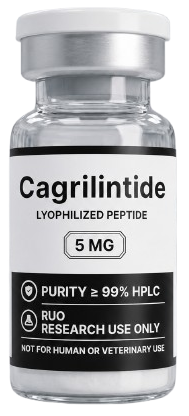
Cagrilintide 5mg is a laboratory research peptide supplied for scientific and analytical applications in Australia. Cagrilintide is a synthetic, long-acting analogue of amylin that has attracted research interest because of its engineered molecular structure, receptor pharmacology and role in experimental metabolic research.
Batch Tested
Certificate of Analysis
Batch PA-0418 — 5mg
View COA
Research Grade Quality
Independently Tested
Cagrilintide 5mg
$119.99
Size / Strength
HPLC Verified
COA Included
Fast Dispatch
Discreet Shipping
100% Quality Guarantee
Every batch of Cagrilintide 5mg is independently third-party tested. 30-day money-back guarantee — no questions asked.
Cagrilintide 5mg – Research Overview
This 5mg presentation is intended exclusively for qualified laboratory research. Researchers can use the information below to review the compound's molecular characteristics, quality documentation, purity testing and storage requirements before selecting materials for laboratory investigations.
Research Highlights
- Independent Laboratory Tested
- Batch-Specific Certificate of Analysis
- Australia-Wide Dispatch
- Research Use Only
What Is Cagrilintide?
Cagrilintide is a synthetic peptide designed as a long-acting analogue of amylin, also known as islet amyloid polypeptide. Native human amylin is a 37-amino-acid peptide hormone. It has been extensively investigated as part of research into metabolic signalling and the biological processes associated with nutrient regulation.
Cagrilintide was developed by modifying the molecular structure of amylin to address several properties that make native amylin challenging to investigate and develop, including its tendency towards aggregation and its relatively short biological persistence.
Published medicinal chemistry research describes cagrilintide as a stable, lipidated, long-acting amylin analogue. Its molecular engineering incorporates several amino-acid substitutions as well as lipidation intended to alter properties such as stability and duration of activity.
These characteristics have made cagrilintide a subject of laboratory, pharmacological and clinical research into amylin-receptor biology.
For Australian laboratories, Cagrilintide Research may therefore be relevant to investigations involving peptide engineering, receptor interactions, molecular stability and experimental metabolic pathways.
Researchers unfamiliar with peptide fundamentals may also find our guides What Are Peptides? and Peptides vs Proteins useful background reading.
Molecular Characteristics of Cagrilintide
Cagrilintide is a chemically modified peptide analogue rather than an identical copy of naturally occurring human amylin.
The molecule contains structural modifications designed during the development of longer-acting amylin analogues. Published research describes modifications intended to improve molecular stability, reduce the tendency towards fibril formation and extend biological persistence.
The 5mg designation refers to the nominal amount of peptide material supplied in the vial. It does not represent a recommended experimental or human dose.
Cagrilintide 5mg Specifications
Because purity and analytical results relate to individual production batches, researchers should rely on the batch-specific Certificate of Analysis (COA) rather than assuming that every manufactured lot has identical analytical results.
See our Understanding Peptide Purity guide for more information about interpreting peptide purity specifications.
Why Researchers Study Cagrilintide 5mg
Scientific interest in cagrilintide largely stems from its relationship to the amylin signalling system.
Amylin is naturally associated with pancreatic beta-cell biology and interacts with specialised receptor systems. Designing modified amylin analogues allows researchers to investigate how structural changes influence receptor activity, molecular stability and pharmacological behaviour.
Amylin Receptor Pharmacology
One important research area involves the interaction between cagrilintide and amylin-related receptor complexes.
Amylin receptors are formed through interactions involving the calcitonin receptor and receptor activity-modifying proteins. Laboratory studies of synthetic analogues can help researchers examine receptor binding, activation and signalling behaviour.
Cagrilintide therefore provides an investigational compound for studying how engineered peptide structures interact with these receptor systems.
Peptide Engineering
Cagrilintide is also scientifically interesting from a medicinal chemistry perspective.
Native amylin presents challenges including aggregation and limited persistence. Researchers developing cagrilintide introduced several structural modifications intended to change these properties.
This makes the molecule relevant to broader questions in peptide science, including:
- structure–activity relationships
- peptide lipidation
- molecular stability
- receptor potency
- aggregation behaviour
peptide half-life engineering; and
modification of naturally occurring peptide sequences.
These principles extend beyond cagrilintide and contribute to the wider development of synthetic and modified peptides.
Metabolic Biology
Cagrilintide has also been investigated experimentally in relation to metabolic signalling pathways.
Research in this area examines the biological role of amylin signalling and how modified analogues interact with physiological systems under controlled experimental conditions.
These investigations include receptor pharmacology, cellular experiments, animal models and formal clinical research.
The existence of clinical research does not mean laboratory-grade cagrilintide products are medicines or suitable for human administration. Research materials sold as Research Use Only Peptides remain distinct from regulated therapeutic products.
Manufacturing and Quality Standards
Producing laboratory peptides requires controlled synthesis, purification, analytical testing and documentation.
Solid-Phase Peptide Synthesis
Synthetic peptides are commonly produced using solid-phase peptide synthesis (SPPS).
During SPPS, amino acids are progressively assembled on a solid support. Protected amino acids are added through controlled coupling cycles until the required peptide chain has been constructed.
Published research concerning cagrilintide describes the use of Fmoc-based peptide synthesis during its development.
Following assembly, the peptide undergoes additional processing appropriate to its molecular structure. Crude material must then be separated from synthesis-related impurities and characterised analytically.
Purification
Preparative chromatography can be used to separate the target peptide from unwanted components generated during synthesis.
Purification is particularly important for complex peptide molecules because incomplete sequences, modified species and synthesis-related impurities may otherwise remain in the final material.
Lyophilisation
Following purification, peptide material may be lyophilised.
Lyophilisation removes water under controlled low-temperature and reduced-pressure conditions, producing dry material that can offer practical advantages for laboratory storage and transport.
Typical Manufacturing Workflow
Raw Materials → Peptide Synthesis → Cleavage/Processing → Purification → Analytical Testing → Lyophilisation → Batch Documentation → Packaging
Each stage should be documented within an appropriate quality system.
For Laboratory Peptides Australia, traceability is particularly valuable because researchers need to identify which analytical documentation corresponds to the material received.
Batch numbers allow a vial to be connected to its relevant test results and Certificate of Analysis.
Research Use Only (RUO)
Research Use Only is not simply a marketing label. It defines the intended purpose of the material.
Cagrilintide 5mg supplied as an RUO peptide is intended for controlled laboratory, analytical and scientific research. It is not being supplied as a medicine, therapeutic product, food, supplement or consumer health product.
Researchers should maintain a clear distinction between scientific literature discussing an investigational compound and the regulatory status of laboratory research material.
A molecule may be investigated in preclinical or clinical studies without laboratory-grade versions sold by research suppliers becoming approved medicines.
Accordingly, Cagrilintide 5mg offered on this website must not be used for self-administration, therapeutic purposes or other human use.
Australian organisations purchasing research materials should maintain appropriate institutional procedures, risk assessments and laboratory controls relevant to their work.
Why Choose Peptides Australia for Cagrilintide 5mg?
Scientific materials should be evaluated on documentation and traceability rather than promotional claims.
Peptides Australia focuses on providing Australian researchers with clear product specifications and quality information for laboratory peptide materials.
Batch-Specific Documentation
Where analytical documentation is provided, researchers can connect the supplied material with its relevant batch information rather than relying solely on a generic purity statement.
Independent Laboratory Testing
Independent analytical testing provides an additional layer of verification separate from manufacturing claims. Depending on the analytical programme, documentation may include chromatographic purity information and identity-related testing.
Learn more in Third-Party Laboratory Testing.
Batch Traceability
Batch identification helps laboratories maintain records connecting received materials with associated analytical documentation.
Secure Packaging
Research peptides require packaging designed to protect material during storage and transport. Products are prepared for secure Australia-wide dispatch with appropriate identification and documentation.
Researchers considering purchasing Cagrilintide in Australia should review the Certificate of Analysis, batch information and available independent testing documentation before selecting laboratory materials.
Research Use Only
This product is intended solely for laboratory research purposes. Not for human consumption.
Cagrilintide 5mg – Storage & Handling
Storage and Laboratory Handling
Peptides are complex molecules that can be affected by environmental conditions.
Heat, moisture, repeated temperature changes and inappropriate light exposure can potentially influence peptide stability over time. Laboratories should therefore establish storage procedures based on the product documentation, analytical requirements and intended experimental protocol.
Lyophilised material should remain securely sealed and protected from unnecessary moisture exposure. Researchers should minimise repeated environmental fluctuations and follow appropriate laboratory procedures when transferring or handling samples.
Long-term storage requirements can vary according to peptide composition, formulation, container system and research protocol. The product's supplied storage instructions should therefore take precedence over general guidance.
Good laboratory practice also requires appropriate sample identification. Labels, batch numbers, receipt dates, storage conditions and analytical documentation should be retained as part of laboratory records where relevant.
See our Peptide Storage Guidelines for broader information about storing research peptide materials.
Cagrilintide 5mg – Technical Specifications
Every batch of Cagrilintide 5mg is independently analysed before dispatch. The values below describe the current research batch.
| Product Name | Cagrilintide 5mg |
|---|---|
| CAS Number | 1415456-99-3 |
| Molecular Formula | C231H346N60O66S |
| Molecular Weight | 4571.3 g/mol |
| Quantity / Strength | 5mg |
| Purity | ≥ 99% (HPLC) |
| Form | Lyophilised Powder |
| Appearance | White Lyophilised Powder |
| Batch Number | PA-0418 |
| Storage Conditions | 2°C to 8°C (Refrigerated) |
| Shelf Life | 24 months from manufacture when stored as specified |
| Category | Weight Loss |
| Intended Use | Research Use Only — not for human consumption |
Cagrilintide 5mg – Certificate of Analysis
Every batch of Cagrilintide 5mg is independently tested before dispatch. View the full COA for the current batch below.
Certificate of Analysis (COA)
Batch Number PA-0418
≥ 99%
Purity
HPLC
Confirmed
Identity
Mass Spec
Pass
Heavy Metals
ICP-MS
Purity Testing and Certificate of Analysis
Analytical documentation is an important consideration when evaluating HPLC Tested Peptides.
A percentage printed on a product page is not a substitute for batch-specific analytical evidence.
HPLC Testing
High-performance liquid chromatography, or HPLC, separates components within a sample according to their physicochemical interactions with the chromatographic system.
For peptide analysis, HPLC can be used to evaluate the relative abundance of the principal peptide peak and detect additional chromatographic peaks associated with impurities or related substances.
However, an HPLC chromatogram alone does not necessarily establish molecular identity.
LC-MS and Mass Analysis
Mass spectrometric techniques provide complementary information by assessing molecular mass.
Used alongside chromatographic testing, mass analysis can strengthen identity verification by determining whether the detected molecular species is consistent with the expected peptide.
Our HPLC vs LC-MS Testing guide explains why these analytical techniques answer different questions.
Understanding the Certificate of Analysis
A useful Certificate of Analysis may include:
- product or compound name
- batch or lot number
- analytical method
- reported purity
- chromatographic results
- molecular identity information
testing date; and
laboratory or testing information.
Researchers should confirm that the batch number on the COA corresponds with the material supplied.
Research Disclaimer
For Research Use Only — Not for Human Consumption
Cagrilintide 5mg is supplied exclusively for Research Use Only (RUO). It is not supplied or approved in Australia as a therapeutic product for human use. This material is not intended for self-administration, diagnosis, treatment, prevention of disease or any other clinical purpose. Information on this page is provided solely for scientific and educational purposes.
- Not for human or veterinary use
- No claims are made regarding safety or efficacy in humans
- Must be handled with appropriate laboratory safety equipment
- Purchaser assumes all responsibility for legal, compliant use
Cagrilintide 5mg – Frequently Asked Questions
Researchers Also Purchase
Why Researchers Choose Us
Research-Grade Quality. Trusted by Researchers Across Australia.
Learn About Our QualityDiscreet Packaging
Fast Australia-Wide Delivery
Expert Support
30-Day Money Back