
Tirzepatide is a synthetic 39-amino-acid peptide studied for its interaction with glucose-dependent insulinotropic polypeptide (GIP) and glucagon-like peptide-1 (GLP-1) receptors. Its engineered structure and dual receptor activity make it relevant to laboratory investigations of receptor pharmacology, cellular signalling, peptide design and metabolic biology.
Batch Tested
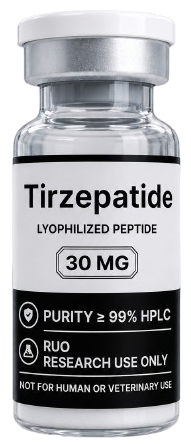
Certificate of Analysis
Batch PA-0376 — 30mg
View COA
Research Grade Quality
Independently Tested
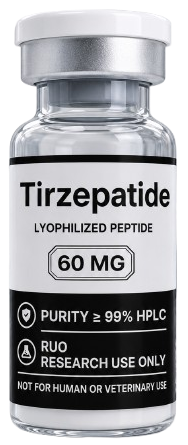
Tirzepatide 30mg
$259.99
Size / Strength
HPLC Verified
COA Included
Fast Dispatch
Discreet Shipping
100% Quality Guarantee
Every batch of Tirzepatide 30mg is independently third-party tested. 30-day money-back guarantee — no questions asked.
Tirzepatide 30mg – Research Overview
Peptides Australia supplies Tirzepatide 30mg as a laboratory research material, supported by batch-level quality documentation for scientific evaluation. The product is intended exclusively for Research Use Only and should be assessed through appropriate analytical records and laboratory procedures.
Research Highlights
- Independent Laboratory Tested
- Batch-Specific COA
- Australia-Wide Dispatch
- Research Use Only
What Is Tirzepatide?
Tirzepatide is an engineered peptide comprising 39 amino acids. From a research perspective, its defining characteristic is activity at two related receptor systems: the glucose-dependent insulinotropic polypeptide receptor (GIPR) and glucagon-like peptide-1 receptor (GLP-1R).
Both receptors belong to the class B family of G protein-coupled receptors and participate in complex biological signalling. The ability to investigate activity across both systems using one molecular structure has made tirzepatide a notable compound in modern peptide research.
Tirzepatide is not simply a naturally occurring peptide reproduced synthetically. Its molecular design incorporates sequence modifications and a lipid-containing side chain. These structural features are scientifically important because researchers can investigate relationships between peptide architecture, receptor interaction, molecular stability and other physicochemical characteristics.
Laboratory production of a peptide with this degree of structural complexity requires controlled synthesis, purification and analytical assessment.
For Australian laboratories, it is also important to distinguish scientific literature about tirzepatide from the quality of a particular research product. Published data describe the molecule and experimental findings; they do not verify an individual supplier's batch.
Researchers requiring introductory background can refer to What Are Peptides? and Peptides vs Proteins before examining more specialised tirzepatide research.
Molecular Characteristics
Tirzepatide is classified as a synthetic modified peptide. It contains 39 amino acids and has a reported molecular weight of approximately 4,813.45 g/mol.
Its molecular formula is C225H348N48O68. The structure includes engineered amino-acid features together with a lipid-containing side chain, contributing to characteristics that distinguish tirzepatide from endogenous GIP and GLP-1.
Research material may be presented in a lyophilised form. Lyophilisation, or freeze-drying, removes water under controlled conditions and produces dry material suitable for controlled laboratory storage.
Tirzepatide 30mg Specifications
Purity figures should always be interpreted alongside the analytical technique and batch documentation supporting them. See Understanding Peptide Purity for more information.
Why Researchers Study Tirzepatide
Scientific interest in tirzepatide spans receptor pharmacology, cellular signalling, experimental metabolic biology and molecular engineering.
Its dual receptor profile provides researchers with a particularly useful model for investigating how an engineered peptide can interact with multiple biological signalling systems.
GIP Receptor Research
GIP is an endogenous incretin peptide. Its receptor, GIPR, participates in biological signalling and has been extensively investigated in metabolic research.
Laboratory studies can examine how an experimental ligand interacts with GIPR, how receptor activation is measured and which downstream signals are observed under controlled conditions.
Tirzepatide provides one model for such investigations.
GLP-1 Receptor Biology
GLP-1R is another class B G protein-coupled receptor studied extensively in cellular and biochemical research.
Experimental systems can be designed to evaluate receptor activation, ligand-receptor interactions and downstream signalling responses. Tirzepatide's activity at GLP-1R therefore contributes another dimension to its research significance.
Dual Receptor Pharmacology
A major area of interest concerns the relationship between GIPR and GLP-1R activity.
Rather than examining each receptor exclusively in isolation, researchers can investigate how an engineered dual-activity peptide behaves across experimental receptor systems.
This can contribute to broader studies of receptor selectivity, signalling profiles and peptide structure-function relationships.
Cellular Signalling
Receptor activation can produce measurable intracellular responses. Laboratory assays may investigate second-messenger pathways, including cyclic AMP signalling, depending on the experimental model.
Such experiments are useful for characterising molecular behaviour under defined conditions.
They should not, however, be interpreted as evidence that a Research Use Only product is appropriate for clinical or personal use.
Peptide Engineering
Tirzepatide also illustrates the increasing sophistication of synthetic peptide design.
Researchers interested in medicinal chemistry and peptide technology can examine how sequence modification, non-standard amino-acid components and lipidation influence molecular properties.
This makes the compound relevant beyond a single area of metabolic research. It can also serve as an investigational model in studies of peptide engineering, receptor pharmacology and molecular optimisation.
Manufacturing and Quality Standards
Peptide quality begins before analytical testing. Controlled synthesis and purification are necessary to produce material suitable for subsequent laboratory assessment.
Solid-Phase Peptide Synthesis
Solid-Phase Peptide Synthesis (SPPS) is a standard technique used to construct synthetic peptides.
The process builds a peptide sequentially while the growing chain remains attached to a solid support. Protected amino-acid derivatives are incorporated in a controlled order, with deprotection and coupling stages repeated until the required sequence is assembled.
For longer or structurally modified peptides, incomplete reactions and side products can create unwanted material. Manufacturing control therefore becomes increasingly important as molecular complexity increases.
Purification
The crude material generated during synthesis is not automatically suitable as finished research material.
Chromatographic purification separates the desired peptide from detectable synthesis-related impurities. The resulting material can then undergo further processing and analytical assessment.
Lyophilisation
Following appropriate purification, peptide material may be lyophilised.
Freeze-drying removes water under controlled low-temperature and reduced-pressure conditions, creating dry material for laboratory storage and transport.
Quality Assessment and Traceability
Finished material should be assigned an identifiable batch or lot number. That identifier connects the physical product with its applicable analytical documentation.
Independent analytical assessment can add another layer of evidence by providing testing data separate from basic supplier specifications.
Manufacturing Timeline
Raw Materials → SPPS → Cleavage → Purification → Analytical Assessment → Lyophilisation → Batch Assignment → COA Documentation → Release
For laboratories evaluating Research Peptides Australia, this chain of documentation is important because reproducible research depends partly on knowing what material was used.
Research Use Only (RUO)
Research Use Only describes the intended application of a laboratory material.
Tirzepatide 30mg supplied under this designation is intended for scientific, analytical and experimental research. It is not supplied as a medicine or therapeutic preparation.
This distinction deserves particular attention with tirzepatide because regulated pharmaceutical products containing tirzepatide also exist.
The presence of the same molecular name does not make an independently supplied RUO research product equivalent to a registered therapeutic good. Pharmaceutical products operate within regulatory and manufacturing frameworks established for medicines.
In Australia, therapeutic goods are regulated by the Therapeutic Goods Administration (TGA). Research materials must be represented and used according to their actual intended purpose.
Universities, biotechnology companies, research institutions and laboratories should maintain suitable procedures for procurement, storage, documentation, access and experimental use.
See Research Use Only Explained for a broader discussion of the distinction between laboratory materials and therapeutic products.
Research Use Disclaimer
Tirzepatide 30mg is supplied exclusively for Research Use Only (RUO) and laboratory analysis. It is not intended for human consumption, self-administration, diagnostic, therapeutic or veterinary use. Researchers must handle and use this material in accordance with applicable Australian requirements and laboratory protocols.
Why Choose Peptides Australia?
Australian researchers assessing peptide suppliers need more than product descriptions. Analytical transparency allows laboratories to make more informed procurement decisions.
Peptides Australia places emphasis on batch documentation, testing information and traceability.
Batch-Specific Certificates of Analysis
A batch-specific COA links analytical results to a particular lot of material. This provides more meaningful information than a generic certificate reused across multiple production batches.
Independent Laboratory Testing
Independent analysis can provide additional evidence about research material quality.
Researchers should examine what was tested, which analytical technique was used and whether the report corresponds to the supplied batch.
Learn more through Third-Party Laboratory Testing.
Batch Traceability
Clear batch identification enables laboratories to document which material was incorporated into individual experiments.
Traceability can become particularly important when comparing results across separate studies or different production lots.
Australia-Wide Dispatch
Domestic distribution provides a practical supply route for laboratories and research organisations across Australia, with secure packaging used to protect research materials during transit.
Quality Documentation
Product specifications, analytical reports and applicable COAs give researchers information they can review before introducing material into laboratory workflows.
Researchers considering purchasing Tirzepatide 30mg in Australia for laboratory investigations should review the batch-specific Certificate of Analysis and applicable independent testing documentation before selecting research materials.
Research Use Only
This product is intended solely for laboratory research purposes. Not for human consumption.
Tirzepatide 30mg – Storage & Handling
Storage and Laboratory Handling
Appropriate storage supports the integrity of research materials between receipt and experimental analysis.
Environmental factors such as temperature, moisture, light and repeated changes in storage conditions can affect peptide materials. Laboratories should therefore follow the storage requirements stated in the applicable product documentation.
Lyophilised material should remain appropriately protected from moisture and unnecessary environmental exposure. Containers should be handled using established laboratory procedures and returned promptly to designated controlled storage.
Transport is another consideration. Secure packaging helps protect research materials during Australia-wide dispatch and reduces unnecessary exposure while the product is in transit.
For longer investigations, laboratories should maintain records that connect storage and handling information with the relevant batch.
Useful records may include the product name, batch identifier, receipt date, storage location and applicable environmental requirements.
Good laboratory practice also means avoiding assumptions that all peptides share identical storage characteristics.
Refer to Peptide Storage Guidelines for further information about managing research peptide materials.
Tirzepatide 30mg – Technical Specifications
Every batch of Tirzepatide 30mg is independently analysed before dispatch. The values below describe the current research batch.
| Product Name | Tirzepatide 30mg |
|---|---|
| CAS Number | 2023788-19-2 |
| Molecular Formula | C225H348N48O68 |
| Molecular Weight | 4813.45 g/mol |
| Quantity / Strength | 30mg |
| Purity | ≥ 99% (HPLC) |
| Form | Lyophilised Powder |
| Appearance | White Lyophilised Powder |
| Batch Number | PA-0376 |
| Storage Conditions | 2°C to 8°C (Refrigerated) |
| Shelf Life | 24 months from manufacture when stored as specified |
| Category | Weight Loss |
| Intended Use | Research Use Only — not for human consumption |
Tirzepatide 30mg – Certificate of Analysis
Every batch of Tirzepatide 30mg is independently tested before dispatch. View the full COA for the current batch below.
Certificate of Analysis (COA)
Batch Number PA-0376
≥ 99%
Purity
HPLC
Confirmed
Identity
Mass Spec
Pass
Heavy Metals
ICP-MS
Purity Testing and Certificate of Analysis
A stated purity percentage should be supported by analytical evidence.
For research peptides, HPLC and mass-based techniques can provide different but complementary information about the material being assessed.
HPLC Purity Analysis
High-performance liquid chromatography separates components according to their behaviour within a defined chromatographic system.
A peptide sample may produce a principal chromatographic peak together with additional detectable peaks. Under the stated analytical conditions, peak-area information can be used to assess chromatographic purity.
Researchers evaluating HPLC Tested Peptides should examine the underlying documentation rather than treating a marketing purity percentage as sufficient evidence.
LC-MS and Identity Verification
Chromatographic purity and molecular identity are not identical concepts.
Mass spectrometry examines molecular mass and can provide evidence relevant to whether analysed material is consistent with the expected molecular species.
LC-MS combines chromatographic separation with mass analysis, making it useful as a complementary technique in peptide characterisation.
See HPLC vs LC-MS Testing for a detailed comparison of what each technique can demonstrate.
Certificate of Analysis
A Certificate of Analysis should provide meaningful information about the batch it represents.
Useful fields can include:
product name
lot or batch number
test date
analytical method
reported chromatographic purity
identity information where applicable
chromatographic or mass-analysis results
testing laboratory information.
Most importantly, researchers should confirm that the certificate corresponds to the material actually supplied.
Our How to Read a Certificate of Analysis guide explains how to interpret common fields.
Research Disclaimer
For Research Use Only — Not for Human Consumption
Tirzepatide 30mg is supplied exclusively for Research Use Only. It is not a registered therapeutic product and is not intended for human or veterinary use, self-administration, diagnosis, treatment, prevention or management of any medical condition. Information on this page is provided for scientific and laboratory education; references to published research describe the literature and are not claims about the supplied material.
- Not for human or veterinary use
- No claims are made regarding safety or efficacy in humans
- Must be handled with appropriate laboratory safety equipment
- Purchaser assumes all responsibility for legal, compliant use
Tirzepatide 30mg – Frequently Asked Questions
Researchers Also Purchase
Why Researchers Choose Us
Research-Grade Quality. Trusted by Researchers Across Australia.
Learn About Our QualityDiscreet Packaging
Fast Australia-Wide Delivery
Expert Support
30-Day Money Back