
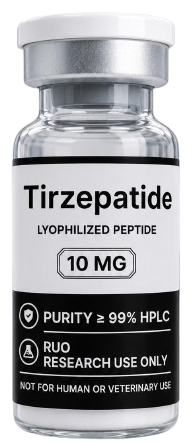
Tirzepatide is a synthetic peptide investigated extensively for its interaction with glucose-dependent insulinotropic polypeptide (GIP) and glucagon-like peptide-1 (GLP-1) receptor pathways. For Australian laboratories, Tirzepatide 10mg provides a defined research material for controlled analytical, biochemical and receptor-based investigations.
Batch Tested
Certificate of Analysis
Batch PA-0370 — 10mg
View COA
Research Grade Quality
Independently Tested
Tirzepatide 10mg
$119.99
Size / Strength
HPLC Verified
COA Included
Fast Dispatch
Discreet Shipping
100% Quality Guarantee
Every batch of Tirzepatide 10mg is independently third-party tested. 30-day money-back guarantee — no questions asked.
Tirzepatide 10mg – Research Overview
Peptides Australia supplies Tirzepatide 10mg exclusively as a laboratory research material. Product quality should be assessed through analytical documentation, batch traceability and appropriate laboratory testing rather than assumptions based solely on labelled quantity or appearance.
Research Highlights
- Independent Laboratory Tested
- Batch-Specific COA
- Australia-Wide Dispatch
- Research Use Only
What Is Tirzepatide?
Tirzepatide is a synthetic peptide engineered to interact with two biologically important receptor systems: the glucose-dependent insulinotropic polypeptide receptor (GIPR) and glucagon-like peptide-1 receptor (GLP-1R). This dual receptor activity distinguishes it from compounds designed primarily around a single incretin pathway.
From a laboratory perspective, Tirzepatide is particularly interesting because researchers can examine how one molecular structure interacts with two related signalling systems. This has generated substantial scientific interest in receptor pharmacology, cellular signalling, metabolic biology and peptide engineering.
The molecule consists of 39 amino acids and incorporates structural modifications intended to influence receptor activity and molecular stability. Its design also includes a lipid-containing side chain, an important feature when considering the relationship between peptide structure and pharmacological behaviour.
Scientific literature on tirzepatide extends beyond basic peptide characterisation into receptor activation, intracellular signalling and experimental metabolic research. These areas make the compound relevant to researchers examining GIP and GLP-1 biology.
For laboratories sourcing Tirzepatide Australia research materials, however, published research and product quality are separate considerations. A research material should have appropriate identity, purity and batch documentation regardless of what has been reported about the molecule in scientific literature.
Molecular Characteristics of Tirzepatide
Tirzepatide is considerably more structurally complex than many short-chain laboratory peptides. It is a 39-amino-acid synthetic peptide with modifications designed to produce specific molecular and receptor-binding characteristics.
Its reported molecular formula is C225H348N48O68, with a molecular weight of approximately 4,813.45 g/mol.
Research-grade material is commonly presented as a lyophilised powder. Lyophilisation removes water under controlled conditions, producing a dry material that can be more suitable for laboratory storage and transport than material maintained in solution.
Tirzepatide 10mg Specifications
Purity is particularly important in analytical peptide work because peptide synthesis can generate truncated sequences, deletion products and other process-related impurities.
Researchers should consult the product's batch-specific Certificate of Analysis (COA) rather than treating a general specification as evidence for the purity of an individual batch.
Why Researchers Study Tirzepatide
Tirzepatide has attracted considerable scientific attention because it provides a model for studying coordinated GIP and GLP-1 receptor activity.
Dual GIP and GLP-1 receptor activity
One of the principal areas of Tirzepatide research is receptor pharmacology.
GIPR and GLP-1R belong to the class B family of G protein-coupled receptors. Researchers investigate receptor activation to understand downstream signalling, receptor selectivity and how structural differences between peptide ligands affect biological responses.
The ability of tirzepatide to interact with both receptor systems provides an experimental framework for investigating signalling relationships that may not be apparent when studying a single receptor pathway independently.
Cellular signalling
Receptor activation can initiate intracellular signalling cascades. Laboratory investigations may therefore examine second messengers, receptor recruitment, cyclic AMP responses and related molecular events under controlled experimental conditions.
Such research can help characterise the functional properties of peptide-receptor interactions without implying that a laboratory peptide product is intended for clinical use.
Metabolic biology
GIP and GLP-1 are endogenous incretin hormones involved in metabolic physiology. Consequently, tirzepatide has been studied extensively in experimental systems investigating glucose regulation, energy balance and associated biological pathways.
Researchers may use cell-based systems, receptor assays, biochemical techniques and animal models depending on the purpose and design of an approved investigation.
Peptide engineering
Tirzepatide is also scientifically interesting from a molecular-design perspective.
Its modified peptide sequence and lipid-containing side chain provide researchers with an example of how peptide engineering can alter properties such as receptor interactions, stability and protein binding.
These characteristics make tirzepatide relevant not only to metabolic research but also to broader investigations into peptide chemistry and drug-design principles.
Research materials supplied by Peptides Australia are intended only for controlled laboratory investigations and should not be interpreted as therapeutic products.
Manufacturing and Quality Standards
Producing a complex synthetic peptide requires multiple controlled stages. Analytical quality therefore depends on much more than the final appearance of the lyophilised material.
Solid-Phase Peptide Synthesis
Synthetic peptides can be produced using Solid-Phase Peptide Synthesis (SPPS).
During SPPS, amino acids are progressively incorporated into a growing peptide chain while it remains attached to a solid support. Protecting groups help prevent unwanted chemical reactions during the assembly process.
For a 39-amino-acid molecule such as tirzepatide, synthesis requires careful control because incomplete coupling or side reactions can generate unwanted peptide-related substances.
Purification
Following synthesis and cleavage, crude material contains the target peptide alongside synthesis-related impurities.
Chromatographic purification can be used to separate the principal peptide component from unwanted material. This stage is critical because a successful synthesis does not automatically establish final purity.
Lyophilisation
Purified material may then undergo freeze-drying, or lyophilisation.
This process removes water under reduced pressure and produces the characteristic dry peptide material used for laboratory storage.
Analytical testing
The finished batch should then undergo appropriate analytical assessment. High-performance liquid chromatography (HPLC) can evaluate chromatographic purity, while mass spectrometric techniques can provide evidence relating to molecular identity.
Typical Manufacturing Timeline
Raw Materials → SPPS → Cleavage → Purification → Analytical Testing → Lyophilisation → Batch Documentation → Release
Each stage contributes to the traceability and reproducibility expected of quality-focused Laboratory Peptides Australia suppliers.
Research Use Only (RUO)
The Research Use Only designation defines the intended purpose of this Tirzepatide 10mg research product.
It is supplied for laboratory, analytical and scientific investigations. It is not supplied as a medicine or as a product for personal administration.
This distinction is particularly important because tirzepatide is also the active ingredient associated with regulated pharmaceutical products. A laboratory research peptide should not be treated as interchangeable with an approved medicine simply because the molecular name is similar.
In Australia, therapeutic goods are subject to regulatory requirements administered by the Therapeutic Goods Administration (TGA). Laboratory research materials exist within a different context and must be represented according to their actual intended purpose.
Researchers, universities, biotechnology organisations and other laboratories should maintain appropriate procurement, storage, documentation and experimental procedures when working with Research Use Only Peptides.
Why Choose Peptides Australia?
For scientific procurement, transparency is more useful than unsupported quality claims.
Peptides Australia focuses on giving Australian researchers access to information that helps them evaluate laboratory materials before use in experimental work.
Batch-Specific Documentation
A Certificate of Analysis should be connected to the batch it describes. Batch-specific documentation improves traceability and allows laboratories to maintain more complete procurement records.
Independent Laboratory Testing
Independent analytical testing provides an additional level of quality assessment beyond supplier statements. Depending on the analytical programme, testing may include chromatographic purity assessment and molecular identity analysis.
Batch Traceability
Batch identifiers allow researchers to connect supplied material with corresponding analytical records. This becomes particularly useful when documenting experimental materials across multiple studies.
Australia-Wide Dispatch
Domestic distribution provides a practical procurement option for Australian laboratories and research organisations requiring appropriately packaged materials.
Secure Packaging
Packaging should protect lyophilised research materials from unnecessary environmental exposure while in transit.
Researchers considering purchasing Tirzepatide in Australia for laboratory investigations should review the relevant Certificate of Analysis, batch details and available independent testing documentation before selecting research materials.
Research Use Only
This product is intended solely for laboratory research purposes. Not for human consumption.
Tirzepatide 10mg – Storage & Handling
Storage and Laboratory Handling
Peptides are sensitive laboratory materials, and their condition can be influenced by temperature, moisture, light and repeated environmental exposure.
Lyophilised tirzepatide should be handled according to the storage conditions stated in the applicable product documentation. Laboratory personnel should minimise unnecessary exposure to moisture and temperature fluctuations and use appropriate controlled storage procedures.
Secure transport packaging also helps protect research materials during Australia-wide dispatch.
Laboratories conducting longer-term studies should establish documented storage procedures so material handling remains consistent throughout an experimental programme. Batch numbers, receipt dates, storage conditions and laboratory access can all form part of good record keeping.
Researchers should also avoid assuming that one universal storage condition applies to every peptide or every physical form. Manufacturer and batch documentation should take precedence.
Tirzepatide 10mg – Technical Specifications
Every batch of Tirzepatide 10mg is independently analysed before dispatch. The values below describe the current research batch.
| Product Name | Tirzepatide 10mg |
|---|---|
| CAS Number | 2023788-19-2 |
| Molecular Formula | C225H348N48O68 |
| Molecular Weight | 4813.45 g/mol |
| Quantity / Strength | 10mg |
| Purity | ≥ 99% (HPLC) |
| Form | Lyophilised Powder |
| Appearance | White Lyophilised Powder |
| Batch Number | PA-0370 |
| Storage Conditions | 2°C to 8°C (Refrigerated) |
| Shelf Life | 24 months from manufacture when stored as specified |
| Category | Weight Loss |
| Intended Use | Research Use Only — not for human consumption |
Tirzepatide 10mg – Certificate of Analysis
Every batch of Tirzepatide 10mg is independently tested before dispatch. View the full COA for the current batch below.
Certificate of Analysis (COA)
Batch Number PA-0370
≥ 99%
Purity
HPLC
Confirmed
Identity
Mass Spec
Pass
Heavy Metals
ICP-MS
Purity Testing and Certificate of Analysis
A label stating "Tirzepatide 10mg" does not independently establish identity or purity. Analytical documentation is therefore an important consideration when evaluating research materials.
HPLC testing
High-performance liquid chromatography separates components according to their physicochemical interactions with the chromatographic system.
For peptide analysis, an HPLC chromatogram can show a principal peak and additional detectable components. The relative peak areas may be used under the specified analytical method to assess chromatographic purity.
Importantly, HPLC purity alone should not be confused with complete molecular identification.
LC-MS and mass analysis
Mass spectrometry provides complementary information by assessing molecular mass. When combined with liquid chromatography, LC-MS can help researchers investigate whether the analysed material is consistent with the expected molecular species.
This is why understanding HPLC vs LC-MS Testing is useful when assessing peptide documentation: the methods answer related but different analytical questions.
Reading a Certificate of Analysis
A batch-specific Certificate of Analysis may include:
product or compound name
batch or lot identifier
analytical method
reported purity
chromatographic information
mass or identity data where applicable
test date
laboratory information.
Researchers should check whether the COA corresponds to the actual batch being supplied rather than relying on generic analytical documentation.
Our How to Read a Certificate of Analysis guide provides further information on interpreting common COA fields.
Research Disclaimer
For Research Use Only — Not for Human Consumption
Tirzepatide 10mg supplied by Peptides Australia is exclusively a Research Use Only (RUO) laboratory material. It is not supplied as a medicine and is not intended for human consumption, self-administration, diagnostic use or therapeutic use. Information on this page is provided solely for scientific and laboratory education. References to published research describe scientific literature and do not constitute medical advice or claims about the supplied research product.
- Not for human or veterinary use
- No claims are made regarding safety or efficacy in humans
- Must be handled with appropriate laboratory safety equipment
- Purchaser assumes all responsibility for legal, compliant use
Tirzepatide 10mg – Frequently Asked Questions
Researchers Also Purchase
Why Researchers Choose Us
Research-Grade Quality. Trusted by Researchers Across Australia.
Learn About Our QualityDiscreet Packaging
Fast Australia-Wide Delivery
Expert Support
30-Day Money Back