
Semaglutide 10mg is an investigational laboratory material used in controlled research examining metabolic signalling and receptor biology. Interest in Semaglutide 10mg research has grown alongside broader scientific investigation of peptide-based signalling compounds and their interactions with biological pathways.
Batch Tested
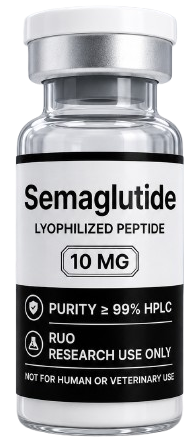
Certificate of Analysis
Batch PA-0403 — 10mg
View COA
Research Grade Quality
Independently Tested
Semaglutide 10mg
$149.99
Size / Strength
HPLC Verified
COA Included
Fast Dispatch
Discreet Shipping
100% Quality Guarantee
Every batch of Semaglutide 10mg is independently third-party tested. 30-day money-back guarantee — no questions asked.
Semaglutide 10mg – Research Overview
For Australian laboratories, material quality, analytical verification and batch traceability are important considerations when sourcing experimental peptides. This page provides scientific and product information about Semaglutide 10mg for laboratory investigations only.
Research Highlights
- Independent Laboratory Tested
- Batch-Specific COA
- Australia-Wide Dispatch
- Research Use Only
Research Use Only: Semaglutide 10mg is supplied exclusively for Research Use Only (RUO) and is not approved in Australia for therapeutic or human use.
What Is Semaglutide 10mg?
Semaglutide 10mg is a synthetic peptide-based investigational compound supplied for laboratory and scientific research. It belongs to a class of molecules designed to interact with the glucagon-like peptide-1 receptor, commonly abbreviated as GLP-1R.
The GLP-1 pathway has become an important area of experimental biology because it is involved in signalling processes associated with glucose regulation, cellular communication, energy balance and metabolic physiology. Controlled laboratory investigations can use Semaglutide 10mg to examine these mechanisms without implying that a research material is intended for clinical use.
Semaglutide 10mg is produced through controlled peptide-manufacturing processes rather than extracted from biological tissue. Synthetic production allows laboratories to work with material manufactured according to defined specifications and subsequently assessed using analytical techniques.
Scientific interest also extends to receptor binding, downstream signalling and the behaviour of peptide-based compounds in experimental models.
Researchers new to this area may find supporting resources such as What Are Peptides? and Peptides vs Proteins useful for understanding the broader molecular context of peptide research.
Molecular Characteristics of Semaglutide 10mg
Semaglutide 10mg is a synthetic peptide analogue containing 31 amino acids and incorporating structural modifications designed to influence molecular stability and receptor interaction. Its molecular formula is C187H291N45O59, with a molecular weight of approximately 4,113.6 g/mol.
Research-grade preparations are commonly supplied as lyophilised material. Lyophilisation removes water under controlled conditions, producing a dry material that is generally more suitable for storage and laboratory transport than material maintained in solution.
Actual purity should always be assessed against the documentation supplied for the specific batch rather than assumed from a general product description.
Semaglutide 10mg Specifications
For more detail on analytical terminology, see Understanding Peptide Purity.
Why Researchers Study Semaglutide 10mg
Semaglutide 10mg attracts scientific attention primarily because of its interaction with GLP-1 receptor signalling.
GLP-1 receptors occur in several biological systems, making the pathway relevant to experimental work investigating receptor activation, intracellular signalling and metabolic regulation. Researchers may use controlled models to examine how receptor agonism influences downstream cellular responses.
One area of investigation concerns glucose-related biology. Laboratory and preclinical studies can explore signalling relationships between GLP-1 receptor activity, insulin-related pathways and nutrient-dependent biological responses. These experiments contribute to a broader understanding of metabolic signalling rather than establishing a use for research-grade material.
Another research area concerns cellular communication. Receptor activation can initiate signalling cascades inside cells, allowing investigators to study receptor pharmacology, signal duration, concentration-dependent responses and interactions between metabolic pathways.
Semaglutide 10mg may also be investigated in experimental models concerned with energy homeostasis and appetite-associated signalling. Such studies are useful for understanding the biological networks that coordinate nutrient sensing and energy regulation.
Molecular stability is another point of scientific interest. Structural modifications can alter how peptide molecules behave under experimental conditions, making comparative research valuable when examining peptide degradation, receptor affinity and biological persistence.
The significance of these investigations lies in understanding mechanisms. Findings from cell cultures, biochemical systems or animal models cannot automatically be translated into outcomes in humans.
Australian researchers assessing Research Use Only Peptides should therefore distinguish clearly between experimental evidence, clinical evidence and the specifications of laboratory materials.
Manufacturing and Quality Standards
Producing research-grade Semaglutide 10mg requires several controlled stages. Peptide manufacture commonly begins with solid-phase peptide synthesis (SPPS), a widely used technique in which amino acids are progressively assembled into a predetermined sequence while attached to a solid support.
Once synthesis is complete, the crude material can contain the target peptide alongside synthesis-related impurities. Purification is therefore a separate and important stage.
Chromatographic techniques can be used to separate the target compound from unwanted components. The purified material is then prepared for analytical assessment and, where appropriate, lyophilised into a stable dry presentation.
A simplified manufacturing pathway looks like this:
Raw Materials → SPPS → Cleavage → Purification → Analytical Testing → Lyophilisation → Batch Documentation → Release
Quality assurance does not depend on one manufacturing step. Documentation, sample identification, analytical results and batch traceability all contribute to determining whether material meets its stated specification.
For Laboratory Peptides Australia researchers, batch-level documentation can be particularly useful because it connects the material received with the analytical information provided by the supplier.
Independent laboratory analysis can add another layer of verification rather than relying exclusively on internal manufacturing information.
See Third-Party Laboratory Testing for a deeper explanation of independent analytical verification.
Research Use Only (RUO)
The Research Use Only designation defines the intended scope of Semaglutide 10mg supplied as a laboratory material.
RUO products are intended for scientific investigation, analytical work and controlled experimental applications. They are not supplied as medicines and should not be represented as products intended to diagnose, prevent or treat disease.
This distinction is particularly important in Australia, where therapeutic products and laboratory research materials operate within different regulatory contexts.
Researchers and institutions should ensure that experimental materials are acquired, stored and used in accordance with their laboratory procedures, applicable regulations and ethical requirements.
Semaglutide 10mg supplied on this website is exclusively a Research Use Only material. It is not approved in Australia for therapeutic or human use.
For further context, read Research Use Only Explained.
Why Choose Peptides Australia for Semaglutide 10mg?
Transparency is an important consideration when evaluating an Australian Peptide Supplier. Product descriptions alone cannot establish material quality; researchers should be able to examine documentation relating to the batch they receive.
Peptides Australia focuses on providing research materials supported by clear analytical and batch information. Semaglutide 10mg is supplied with batch-specific documentation so laboratories can review relevant information before beginning experimental work.
Independent laboratory testing provides additional analytical information, while batch traceability helps connect documentation to the supplied material.
Secure packaging is used to protect research materials during Australia-wide dispatch. Supporting documentation is intended to make it easier for laboratories to maintain internal records and evaluate materials before experimental use.
Researchers considering purchasing Semaglutide 10mg in Australia should review the Certificate of Analysis and available independent testing documentation before selecting laboratory materials.
This approach is particularly relevant when comparing Research Peptides Australia suppliers, where transparency and verifiable documentation can be more informative than promotional purity claims.
Research Use Only
This product is intended solely for laboratory research purposes. Not for human consumption.
Semaglutide 10mg – Storage & Handling
Storage and Laboratory Handling
Appropriate storage helps protect research materials from avoidable degradation.
Peptides can be affected by heat, moisture, light and repeated environmental changes. Lyophilised Semaglutide 10mg should therefore remain securely sealed and be stored according to the conditions stated in the supplier's product documentation or batch-specific handling information.
Laboratories should minimise unnecessary exposure to moisture and direct light. Containers should also be clearly labelled so that batch identity remains traceable throughout the research process.
During transport, secure packaging can help protect the vial or container from physical damage and excessive environmental exposure.
Long-term laboratory storage should follow established institutional procedures, supplier documentation and appropriate laboratory protocols.
The Peptide Storage Guidelines resource provides further information about maintaining research materials under controlled laboratory conditions.
Semaglutide 10mg – Technical Specifications
Every batch of Semaglutide 10mg is independently analysed before dispatch. The values below describe the current research batch.
| Product Name | Semaglutide 10mg |
|---|---|
| CAS Number | 910463-68-2 |
| Molecular Formula | C187H291N45O59 |
| Molecular Weight | 4113.58 g/mol |
| Quantity / Strength | 10mg |
| Purity | ≥ 99% (HPLC) |
| Form | Lyophilised Powder |
| Appearance | White Lyophilised Powder |
| Batch Number | PA-0403 |
| Storage Conditions | 2°C to 8°C (Refrigerated) |
| Shelf Life | 24 months from manufacture when stored as specified |
| Category | Weight Loss |
| Intended Use | Research Use Only — not for human consumption |
Semaglutide 10mg – Certificate of Analysis
Every batch of Semaglutide 10mg is independently tested before dispatch. View the full COA for the current batch below.
Certificate of Analysis (COA)
Batch Number PA-0403
≥ 99%
Purity
HPLC
Confirmed
Identity
Mass Spec
Pass
Heavy Metals
ICP-MS
Purity Testing and Certificate of Analysis
Analytical testing helps laboratories evaluate the identity and composition of Semaglutide 10mg.
High-performance liquid chromatography, or HPLC, is commonly used to assess chromatographic purity. The technique separates components within a sample and produces a chromatogram containing peaks associated with detected compounds.
The relative area of the primary peak can provide information about sample purity under the analytical conditions used. However, HPLC should not be interpreted as complete molecular identification on its own.
Mass spectrometry, including LC-MS-based analysis, can provide complementary information by assessing molecular mass and supporting identity verification.
This distinction matters when comparing HPLC Tested Peptides. A high reported chromatographic purity percentage and confirmation that the material has the expected molecular identity answer related but different analytical questions.
A Certificate of Analysis (COA) should ideally identify the batch or lot tested and present relevant analytical results. Researchers should check whether the document corresponds to the physical batch supplied.
Before accepting a purity percentage at face value, laboratories should consider the analytical method, sample identification and supporting documentation.
For additional guidance, see HPLC vs LC-MS Testing and How to Read a Certificate of Analysis.
Research Disclaimer
For Research Use Only — Not for Human Consumption
Semaglutide 10mg is supplied exclusively for Research Use Only (RUO). It is intended for laboratory, analytical and scientific investigation and is not approved in Australia for therapeutic or human use. It is not supplied as a medicine and must not be used for self-administration, diagnosis, prevention or treatment of any medical condition.
- Not for human or veterinary use
- No claims are made regarding safety or efficacy in humans
- Must be handled with appropriate laboratory safety equipment
- Purchaser assumes all responsibility for legal, compliant use
Semaglutide 10mg – Frequently Asked Questions
Researchers Also Purchase
Why Researchers Choose Us
Research-Grade Quality. Trusted by Researchers Across Australia.
Learn About Our QualityDiscreet Packaging
Fast Australia-Wide Delivery
Expert Support
30-Day Money Back