
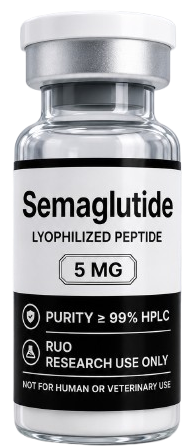
Semaglutide 5mg is an investigational peptide material used in controlled laboratory research involving glucagon-like peptide-1 (GLP-1) receptor biology, metabolic signalling and related biochemical pathways. Its long-acting molecular design has made semaglutide an important reference compound in experimental research examining receptor activation and downstream cellular responses.
Batch Tested
Certificate of Analysis
Batch PA-0400 — 5mg
View COA
Research Grade Quality
Independently Tested
Semaglutide 5mg
$89.99
Size / Strength
HPLC Verified
COA Included
Fast Dispatch
Discreet Shipping
100% Quality Guarantee
Every batch of Semaglutide 5mg is independently third-party tested. 30-day money-back guarantee — no questions asked.
Semaglutide 5mg – Research Overview
Peptides Australia supplies Semaglutide 5mg as a Research Use Only (RUO) laboratory material for qualified research applications. Product assessment should be based on analytical identity, purity, batch documentation and appropriate laboratory handling rather than therapeutic claims.
Research Highlights
- Independent Laboratory Tested
- Batch-Specific Certificate of Analysis
- Australia-Wide Dispatch
- Research Use Only
What Is Semaglutide 5mg?
Semaglutide is a synthetic peptide analogue structurally related to human glucagon-like peptide-1 (GLP-1), an endogenous peptide hormone involved in several metabolic signalling pathways. Native GLP-1 is rapidly degraded in biological systems, which historically created limitations for researchers studying prolonged GLP-1 receptor activation.
Semaglutide was designed with specific molecular modifications that increase resistance to enzymatic degradation and extend molecular persistence compared with native GLP-1. One important modification involves substitution at a position associated with cleavage by dipeptidyl peptidase-4 (DPP-4). The molecule also incorporates a fatty-acid-containing side chain that contributes to albumin association.
These properties have made semaglutide scientifically useful for investigating GLP-1 receptor pharmacology, ligand–receptor interactions and prolonged signalling responses.
Within an Australian laboratory context, Semaglutide 5mg Research material may be used as an experimental reference compound in appropriately designed analytical, biochemical or preclinical studies.
The 5mg designation identifies the nominal quantity of peptide material supplied. It should not be interpreted as a recommendation for administration or human use.
For researchers new to this field, supporting resources such as What Are Peptides? and Peptides vs Proteins can provide useful background on peptide structure and laboratory research.
Molecular Characteristics of Semaglutide
Semaglutide is a modified peptide containing 31 amino acids. Its structure is based on GLP-1 while incorporating substitutions and a lipid side-chain modification designed to alter its biochemical behaviour.
The molecule has an approximate molecular weight of 4,113.6 Da, although analytical documentation for an individual research batch should always be consulted when confirming material identity.
Research-grade Semaglutide 5mg is commonly supplied as a lyophilised material. Lyophilisation removes water under controlled conditions and can assist with maintaining the stability of peptide materials during storage.
Semaglutide 5mg Specifications
Purity, identity and other analytical characteristics should be evaluated against the Certificate of Analysis (COA) associated with the specific batch rather than assumed from general product descriptions.
Why Researchers Study Semaglutide
Scientific interest in semaglutide is primarily connected with GLP-1 receptor biology. The GLP-1 receptor is a G protein-coupled receptor expressed in multiple tissues and forms part of a broader network of metabolic and cellular signalling pathways.
GLP-1 receptor signalling
Semaglutide provides researchers with a modified ligand for investigating GLP-1 receptor activation. Laboratory studies may examine receptor binding, intracellular signalling and downstream biochemical responses under carefully controlled experimental conditions.
Cellular signalling pathways
Activation of GLP-1 receptors is associated with intracellular signalling involving cyclic adenosine monophosphate (cAMP) and related molecular processes. Experimental models allow researchers to examine how receptor activation influences signalling dynamics at cellular and molecular levels.
Metabolic research
Semaglutide has been extensively investigated in metabolic science. Depending on the experimental model, researchers may study glucose-associated signalling, energy-balance pathways, receptor pharmacology and interactions between endocrine signals.
These investigations should be distinguished from claims about what an RUO peptide will do in people. Findings from experimental systems do not automatically establish a clinical outcome.
Molecular persistence
Another area of scientific interest is semaglutide's modified structure. Native GLP-1 has a short biological persistence because it is susceptible to enzymatic degradation. Semaglutide's structural modifications allow researchers to investigate how molecular engineering can alter peptide stability and receptor activity.
Experimental models
Research involving semaglutide spans biochemical assays, cell-based investigations and controlled preclinical models. Different models answer different scientific questions, making experimental design and interpretation particularly important.
For researchers comparing compounds used in metabolic research, analytical quality should remain separate from biological interpretation. High peptide purity confirms characteristics of a laboratory material; it does not prove a therapeutic effect.
Manufacturing and Quality Standards
Producing research peptides requires multiple controlled stages. Semaglutide's modified structure also makes analytical verification important because researchers need confidence that the material being evaluated corresponds to the expected molecular identity.
Solid Phase Peptide Synthesis
Research peptides are commonly produced using Solid Phase Peptide Synthesis (SPPS). During SPPS, amino acids are sequentially incorporated while the developing peptide remains attached to a solid support.
Protecting groups help control chemical reactions during assembly. After synthesis, the peptide is cleaved from the support and processed for subsequent purification.
For modified peptides such as semaglutide, manufacturing also needs to account for the molecule's structural modifications.
Purification and analytical assessment
Crude peptide material can contain incomplete sequences and synthesis-related impurities. Purification therefore represents a separate and important stage of production.
A simplified workflow is:
Raw Materials → Peptide Synthesis → Cleavage → Purification → Analytical Testing → Lyophilisation → Batch Documentation → Release
After purification, analytical techniques can assess whether the material meets defined specifications.
Lyophilisation then converts the purified peptide preparation into a more stable dry form suitable for controlled laboratory storage and transport.
Batch traceability connects the supplied vial with its analytical records. This allows Australian laboratories to evaluate documentation for the actual batch received rather than relying solely on generic purity statements.
Researchers interested in this process can also consult Third-Party Laboratory Testing and Understanding Peptide Purity for additional information.
Research Use Only in Australia
Research Use Only (RUO) describes materials supplied for laboratory investigation rather than clinical or therapeutic application.
This distinction is particularly important with semaglutide because approved medicines containing semaglutide also exist. A research peptide sold as an RUO material should not be treated as equivalent to a registered medicine simply because the active molecular name appears similar.
Research materials and therapeutic products operate in different regulatory, manufacturing and quality frameworks.
Semaglutide 5mg supplied as an experimental laboratory peptide is intended for legitimate scientific work, such as analytical assays, biochemical investigations and appropriately authorised experimental research.
Researchers should ensure their work complies with applicable Australian institutional, ethical, regulatory and laboratory requirements.
For additional context about this distinction, see Research Use Only Explained.
Important disclaimer: Semaglutide 5mg offered as an RUO laboratory product is supplied exclusively for Research Use Only and is not supplied or represented as an approved therapeutic product for human use in Australia. It is not intended for self-administration, diagnosis, treatment or other clinical purposes.
Why Choose Peptides Australia for Semaglutide 5mg Research Material?
For laboratory procurement, transparency is more useful than unsupported marketing claims. Researchers need enough documentation to evaluate what they are receiving and determine whether a material is appropriate for their experimental requirements.
Peptides Australia focuses on providing research materials supported by clear product and batch information.
Key considerations include:
- batch-specific COA availability
- independent laboratory testing documentation where applicable
- analytical purity information
- batch traceability
- secure packaging
- Australia-wide dispatch
clearly stated Research Use Only status.
Researchers considering purchasing research peptides in Australia should review the Certificate of Analysis, analytical methods and batch documentation before selecting laboratory materials.
This documentation-first approach allows laboratories to make their own assessment rather than relying exclusively on a headline purity figure.
Researchers comparing an Australian Peptide Supplier can also review Third-Party Laboratory Testing, Understanding Peptide Purity and the site's COA resources before making procurement decisions.
Research Use Only
This product is intended solely for laboratory research purposes. Not for human consumption.
Semaglutide 5mg – Storage & Handling
Storage and Laboratory Handling
Peptides are sensitive laboratory materials, and inappropriate storage conditions may affect their integrity over time.
Lyophilised Semaglutide 5mg should be maintained according to the storage conditions specified by the supplier and relevant batch documentation. Laboratories should minimise unnecessary exposure to moisture, strong light, heat and repeated temperature fluctuations.
Cold-chain or temperature-controlled practices may be appropriate where specified for the material. Researchers should also document receipt, storage conditions, batch identifiers and movement of laboratory materials as part of good laboratory practice.
Long-term storage requirements can differ from short-term handling conditions. The supplier's documented specifications should therefore take precedence over generic online advice.
See Peptide Storage Guidelines for broader information about managing research peptides in laboratory environments.
Semaglutide 5mg – Technical Specifications
Every batch of Semaglutide 5mg is independently analysed before dispatch. The values below describe the current research batch.
| Product Name | Semaglutide 5mg |
|---|---|
| CAS Number | 910463-68-2 |
| Molecular Formula | C187H291N45O59 |
| Molecular Weight | 4113.58 g/mol |
| Quantity / Strength | 5mg |
| Purity | ≥ 99% (HPLC) |
| Form | Lyophilised Powder |
| Appearance | White Lyophilised Powder |
| Batch Number | PA-0400 |
| Storage Conditions | 2°C to 8°C (Refrigerated) |
| Shelf Life | 24 months from manufacture when stored as specified |
| Category | Weight Loss |
| Intended Use | Research Use Only — not for human consumption |
Semaglutide 5mg – Certificate of Analysis
Every batch of Semaglutide 5mg is independently tested before dispatch. View the full COA for the current batch below.
Certificate of Analysis (COA)
Batch Number PA-0400
≥ 99%
Purity
HPLC
Confirmed
Identity
Mass Spec
Pass
Heavy Metals
ICP-MS
Purity Testing and Certificate of Analysis
Analytical documentation is an important consideration when sourcing HPLC Tested Peptides for laboratory work.
HPLC
High-performance liquid chromatography (HPLC) separates components within a sample according to their interactions with a chromatographic system. The resulting chromatogram can help laboratories assess relative purity and detect certain impurities.
A reported HPLC purity percentage should not, however, be confused with confirmation of molecular identity.
LC-MS and mass analysis
Mass spectrometric techniques provide information about molecular mass and can help determine whether the analysed material is consistent with the expected peptide.
HPLC and mass spectrometry therefore answer different analytical questions. Researchers can explore these distinctions further in HPLC vs LC-MS Testing.
Reading a Certificate of Analysis
A useful Certificate of Analysis may identify:
- product or compound name
- batch or lot number
- analytical method
- reported purity
- molecular identity information where tested
- testing date or related analytical details
The batch number on the supplied research material should correspond with its documentation.
For a deeper explanation, see How to Read a Certificate of Analysis.
Research Disclaimer
For Research Use Only — Not for Human Consumption
Semaglutide 5mg described on this page is intended exclusively for laboratory research and Research Use Only (RUO). It is not supplied or represented as a medicine and is not intended for human or veterinary administration, self-administration, diagnosis, treatment, cure or prevention of any disease. References to scientific research describe areas investigated in the scientific literature and do not constitute medical or therapeutic claims. Researchers are responsible for ensuring that acquisition, storage and use comply with applicable Australian laws, institutional requirements and laboratory protocols.
- Not for human or veterinary use
- No claims are made regarding safety or efficacy in humans
- Must be handled with appropriate laboratory safety equipment
- Purchaser assumes all responsibility for legal, compliant use
Semaglutide 5mg – Frequently Asked Questions
Researchers Also Purchase
Why Researchers Choose Us
Research-Grade Quality. Trusted by Researchers Across Australia.
Learn About Our QualityDiscreet Packaging
Fast Australia-Wide Delivery
Expert Support
30-Day Money Back