
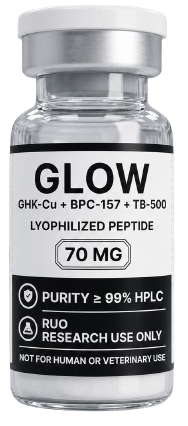
GLOW is a blend of peptides that has been studied within laboratory studies of peptide chemistry, molecular signaling, cellular biology, and research models. This is a mixture of certain peptides, which have been studied by researchers in order to explore the relationship between various molecular pathways.
Certificate of Analysis
Batch PA-0114 — 70mg
View COA
Research Grade Quality
Independently Tested
GLOW Blend
$165.99
Size / Strength
HPLC Verified
COA Included
Fast Dispatch
Discreet Shipping
100% Quality Guarantee
Every batch of GLOW Blend is independently third-party tested. 30-day money-back guarantee — no questions asked.
GLOW Blend – Research Overview
The field of combination peptide research is increasingly developing in life sciences since the use of several peptide sequences can give researchers an opportunity to study complex communication systems, structural properties, and molecular interactions within a laboratory setting.
GLOW 70 mg is provided only for research purposes at Peptides Australia as a Research Use Only (RUO) laboratory item. Every batch is accompanied by documentation that includes analytical testing and batch-specific Certificate of Analysis (COA).
Research Highlights
- Independent Laboratory Tested
- Batch-Specific Certificate of Analysis
- Australia-Wide Dispatch
- Research Use Only
- HPLC Tested Peptide Material
What is GLOW?
GLOW is a research peptide blend which has been developed by scientists in order to carry out experiments in relation to peptide interaction and signalling pathways.
Unlike single compound research peptides, peptide blends consist of several compounds and thus researchers can examine these components both independently and as part of the blend to determine their behavior in the experiment.
GLOW peptide blend is used in cosmetic and cell research as a result of scientific interest in peptide signalling, skin biology models, and molecular pathways. Nevertheless, research application is restricted to laboratory studies only.
GLOW is not used as a cosmetic, pharmaceutical or medical product.
Scientific Background of Peptide Blends
Peptide research has been expanding greatly owing to development of molecular biology, analytical chemistry and biotechnology.
Peptides are studied by scientists because of their participation in many biological processes such as:
- Cell communication
- Molecular signalling
- Protein interaction
- Biological pathway research
Synthetic peptide blends help researchers to study behavior of peptide structures and molecular properties in experimental conditions.
Components of GLOW Research Blend
The mixture of the GLOW could consist of several different peptides selected to conduct research.
It is expected that a peptide combination for research would usually have such characteristics as:
- Peptide structure
- Molecular compatibility
- Signalling pathways
- Analytical characteristics
Therefore, the exact composition of a peptide mixture must be specified in the documentation provided by the company.
Scientists must carefully study product specifications and Certificates of Analysis prior to any laboratory research.
Molecular Properties of GLOW
As it was already mentioned, GLOW is a peptide mixture, not a peptide compound.
Product Specification Table
Peptide Structure and Composition
Peptides are organic substances composed of amino acids held together by peptide bonds.
Research of peptide structure is important as the sequence of amino acids affects:
- Molecular characteristics
- Chemical activity
- Stability characteristics
- Biological activity
Knowledge of the peptide structure is vital for current research in biotechnology.
Lyophilised Powder Formulation
GLOW is provided in a lyophilised powder form. Lyophilization is a controlled freeze-drying technique, which is frequently applied for laboratory peptides. The removal of moisture is done under control to ensure consistency in storage and transportation. Advantages of lyophilized research materials are:
- Reduced moisture exposure
- Consistent storage
- Convenient documentation in the laboratory
- Controlled handling procedure
Laboratory protocol must be followed when handling lyophilized peptides.
Stability Factors
Peptide stability may be affected by external conditions. Conditions that researchers take into account usually include:
- Exposure to temperature
- Moisture content
- Exposure to light
- Packing conditions
- Duration of storage
Good storage conditions will help to preserve the quality of research materials.
Researchers are welcome to use additional educational sources:
- Peptide Purity Understanding
- Peptide Storage Guidelines
- How to Read a Certificate of Analysis
Why Researchers Study GLOW
The scientific rationale behind GLOW is the chance of exploring various peptide combinations and the chemistry behind it in controlled laboratory settings.
Science is concerned more about studying biological mechanisms than proving any therapy.
Peptide Signalling Studies
Peptides serve as an important means of communication within various biological organisms.
Scientists conduct peptide signalling studies to find out about:
- Molecular communications
- Receptor interaction studies
- Cellular responses
- Regulation of biological pathways
GLOW is a research tool that can be used to explore peptide mechanisms.
Cellular Biology Studies
Cellular biology studies are aimed at finding out how cells interact with each other.
Scientists can use peptide blends to study:
- Cellular signalling networks
- Molecular interactions
- Experimental responses
- Biological mechanisms
Studies of Molecular Interactions
Combination peptide studies give the chance to scientists to study interactions between various molecules.
Fields of study can include:
- Compatibility studies of peptides
- Structure analyses
- Characterisation of molecules
- Analytical studies
Such studies provide scientists with information about peptide chemistry.
Skin Biology Research Context
There are several areas in peptide research that relate to skin physiology.
In peptide research, scientists explore molecular pathways related to:
- Communication between cells
- Protein-protein interactions
- Signaling pathways of molecules
Such research is done to advance the science and does not imply any approved cosmetic or therapeutic use.
Research Experiment Models
GLOW may be researched using the following laboratory models:
- Analytical chemistry tests
- Cell-based research models
- Molecular analysis
- Peptide characterization
The aim of such studies is to increase the body of scientific knowledge regarding peptides.
Production & Quality Control
To produce peptide blends for research, controlled manufacturing, analytical validation, and documentation are required.
GLOW 70mg is synthesized as a research peptide blend based on the principles of peptide manufacturing to ensure consistency, traceability, and proper analysis in laboratories.
Since peptide blends consist of several ingredients, quality control requires comprehensive documentation of all the components of the mixture along with its analytical features.
The process of quality-oriented peptide manufacturing provides:
- Well-defined peptide composition
- Consistent characteristics of each batch
- Analytical validation
- Transparency of documentation
These steps will help the scientists analyze laboratory material prior to conducting scientific research.
Solid Phase Peptide Synthesis (SPPS)
Most of the peptides used in research are synthesized through Solid Phase Peptide Synthesis (SPPS).
SPPS is a known chemical synthesis process where amino acids are organized in a specific order to form particular peptide structures.
The general procedure for peptide synthesis includes:
- Peptide sequence design
- Amino acids assembly
- Release from synthesis supporting materials
- Purification
- Analysis
- Lyophilisation
- Batches documentation
This procedure helps scientists to obtain peptides that have defined molecular properties useful for research purposes.
Purification Process
Once synthesized, the peptide ingredients go through the purification procedure to isolate the required ingredients from others that do not belong to the ingredients list.
Purification helps to isolate:
- Partial peptide products
- Synthesis residues
- Related peptide products
- Process impurities
In case of peptide mixes, the analysis process will help to verify the properties of the end product.
Lyophilisation Process
After purification and analysis procedures, the peptides for research purposes are usually presented as lyophilized powders.
Lyophilization is a process that involves freezing and drying to decrease water content.
Benefits of lyophilized peptides include:
- Low water exposure
- Increased storage consistency
- Ease of laboratory handling
- Increased documentation control
Scientists should follow proper laboratory guidelines in the handling of lyophilized research products.
Research Use Only (RUO)
GLOW 70mg supplied by Peptides Australia is a laboratory Research Use Only (RUO) material only.
It is to be used for:
- Scientific research
- Laboratory analyses
- Education and research
- Controlled experiments
GLOW 70mg is not indicated for therapeutic, diagnostic, cosmetic, veterinary, and human use in Australia.
Research Material vs Consumer Product
Research peptides and consumer product have their uses.
Regulated products must go through evaluation processes that include:
- Safety testing
- Manufacturing process check
- Regulatory compliance
- Indications
RUO is for scientific research purpose and is not to be used as medicine or cosmetics.
Responsible Scientific Research
Researchers and organizations using RUO materials must ensure compliance with:
- Organizational requirements
- Laboratory safety procedures
- Scientific research requirements
- Australian regulations
GLOW 70mg should be used in laboratories only.
Why Choose Peptides Australia?
Valid scientific research relies on the provision of adequate documentation, accurate information, and quality laboratory materials.
Peptides Australia facilitates scientists' work through offering them adequate documentation for:
- Universities
- Biotech companies
- Research laboratories
- Scientific institutes
Batch-Specific Certificate of Analysis
Batch-specific COA offers information related to each particular product.
This allows:
- Laboratory documentation
- Material verification
- Research traceability
Independent Laboratory Testing
Independent laboratory analysis gives scientists information about:
- Peptide features
- Purity of products
- Batch consistency
Research Use Only
This product is intended solely for laboratory research purposes. Not for human consumption.
GLOW Blend – Storage & Handling
Storage and Laboratory Handling
Appropriate storage and handling is an important aspect to keep in mind while considering the quality of the research material.
GLOW is provided as a lyophilized powder and must be handled using proper laboratory guidelines.
Temperature Aspects
It is recommended for researchers to take into account the storage environments that will not lead to any additional environmental changes.
Key aspects are as follows:
- Sufficient maintenance of recommended storage conditions
- Minimization of any possible temperature variations
- Proper protection of materials during transportation
Protection Against Moisture
It is necessary to provide lyophilized peptides from any moisture contamination.
Proper laboratory handling can involve:
- Proper sealing of materials
- Prevention of humidification
- Following of manufacturer’s instructions for storage
Light Protection
Researchers are advised to provide protection of peptides from excessive light exposure.
Controlled storage ensures consistency of the research materials.
Laboratory Documentation
Scientific laboratories usually keep records for:
- Batch information
- Storage details
- Product specifications
- Experimental procedures
Proper record-keeping ensures proper laboratory quality management.
Further reading could include:
- Peptide Storage Instructions
- Reading Certificate of Analysis
- Quality Control in Laboratories
GLOW Blend – Technical Specifications
Every batch of GLOW Blend is independently analysed before dispatch. The values below describe the current research batch.
| Product Name | GLOW Blend |
|---|---|
| CAS Number | 137525-51-0 | 77591-33-4 | 89030-95-5 |
| Molecular Formula | C₆₂H₉₈N₁₆O₂₂ | C₂₁₂H₃₅₀N₅₆O₇₈S | C₁₄H₂₂CuN₆O₄ |
| Molecular Weight | 1419.5 g/mol | 4963.5 g/mol | 401.9 g/mol |
| Quantity / Strength | BPC-157 10mg | TB-500 10mg | GHK-Cu 50mg |
| Purity | ≥ 99% (HPLC) |
| Form | Lyophilised Powder |
| Appearance | White Lyophilised Powder |
| Batch Number | PA-0114 |
| Storage Conditions | 2°C-8°C (Refrigerated) |
| Category | Longevity & Anti-Aging |
| Intended Use | Research Use Only — not for human consumption |
GLOW Blend – Certificate of Analysis
Every batch of GLOW Blend is independently tested before dispatch. View the full COA for the current batch below.
Certificate of Analysis (COA)
Batch Number PA-0114
≥ 99%
Purity
HPLC
Confirmed
Identity
Mass Spec
Pass
Heavy Metals
ICP-MS
| COA Information | Purpose |
|---|---|
| Product Name | Confirms material identification |
| Batch Number | Supports traceability |
| Purity Results | Provides analytical evaluation |
| Testing Methods | Identifies laboratory techniques |
| Identity Information | Supports compound confirmation |
| Quality Review | Documents assessment |
Batch Traceability and Quality Documentation
Traceability is one of the key aspects of responsible research peptides supply.
Batch traceability and documentation can include:
- Product identification
- Batch number
- Analytical testing results
- Quality criteria
- Storage
Record keeping is useful for research organizations, universities, and laboratories in tracking materials utilized in their scientific processes.
Purity Testing and Certificate of Analysis (COA)
Analytical testing gives researchers information about the composition, identity, and characteristics of the peptides.
Labs usually check documentation like:
- Purity data
- Analytical testing results
- Identity confirmation
- Batch records
High-Performance Liquid Chromatography (HPLC)
High-Performance Liquid Chromatography (HPLC) is one of the most popular methods for purity testing of peptides.
This method involves separation of elements in the sample and production of chromatograms which researchers analyze.
HPLC testing can reveal information about:
- Purity percentage
- Peptides composition
- Impurities
- Sample homogeneity
Comparison between batches
HPLC testing is often used in biotech, peptide synthesis, and academic laboratories.
Researcher who are interested in analytical testing can find more about:
- Understanding Peptide Purity
- HPLC vs LC-MS Testing
- Third-Party Laboratory Testing
LC-MS Identity Testing
Liquid Chromatography-Mass Spectrometry (LC-MS) is usually used for identification of the molecular identity.
By means of LC-MS testing researchers can assess:
- - Molecular weight
- - Expected peptide identity
- - Structural properties
Application of several analytical methods allows obtaining extra data on research material properties.
Certificate of Analysis Explained
A Certificate of Analysis (COA) is a quality certificate that contains analytical data of a research peptide product per batch.
A typical COA may include:
COA permits the assessment of the specification of the laboratory material prior to initiating research activities.
Researchers interested in acquiring GLOW in Australia are encouraged to look into the available Certificate of Analysis data, testing results and quality standards of the supplier prior to choosing laboratory peptides.
Quality Documentation
Accurate documentation enables scientists to consider:
- Specifications of products
- Analysis methods used
- Quality information provided
Secure Packaging
Proper packaging ensures protection of lyophilised research materials during delivery.
Australia Wide Delivery
Reliable delivery ensures that:
- Research institutes
- Universities
- Biotech companies
- Scientific laboratories
Scientists intending to buy GLOW in Australia need to take into account product documentation, Certificate of Analysis availability, analytical testing information, and Research Use Only status of peptides.
Research Disclaimer
For Research Use Only — Not for Human Consumption
This content is provided for educational, scientific and research-information purposes only. It does not provide medical advice, treatment recommendations or personal dosage instructions. Available evidence concerning the peptides contained in GLOW is derived from preclinical research and ongoing or completed clinical investigations of the individual components. Further research is required to better understand the safety, pharmacology and potential efficacy of this peptide combination for specific research applications.
- Not for human or veterinary use
- No claims are made regarding safety or efficacy in humans
- Must be handled with appropriate laboratory safety equipment
- Purchaser assumes all responsibility for legal, compliant use
References
5 sources- 1Pickart L, Margolina A. Regenerative and Protective Actions of the GHK-Cu Peptide in the Light of the New Gene Data. International Journal of Molecular Sciences. 2018;19(7):1987. PubMed: https://pubmed.ncbi.nlm.nih.gov/29986520/PubMed: https://pubmed.ncbi.nlm.nih.gov/29986520/
- 2Sikiric P, Seiwerth S, Rucman R, et al. Stable Gastric Pentadecapeptide BPC 157: Novel Therapy in Gastrointestinal Tract. Current Pharmaceutical Design. 2011;17(16):1612-1632.PubMed: https://pubmed.ncbi.nlm.nih.gov/21548867/
- 3Gwyer D, Wragg NM, Wilson SL. Gastric Pentadecapeptide Body Protection Compound BPC 157 and Its Role in Accelerating Musculoskeletal Soft Tissue Healing. Cell and Tissue Research. 2019;377(2):153-159.PubMed: https://pubmed.ncbi.nlm.nih.gov/30915550/
- 4Huff T, Müller CSG, Otto AM, Netzker R, Hannappel E. β-Thymosins, Small Acidic Peptides with Multiple Functions. International Journal of Biochemistry & Cell Biology. 2001;33(3):205-220.PubMed: https://pubmed.ncbi.nlm.nih.gov/11240368/
- 5Australian Government, Therapeutic Goods Administration (TGA). Concerns Regarding the Public Health Risks Associated with Unapproved Peptide Products. Therapeutic Goods Administration. 4 July 2026.TGA: https://www.tga.gov.au/news/media-releases/concerns-regarding-public-health-risks-associated-unapproved-peptide-products
Citations are provided for research reference and open in a new tab. Listing a study does not imply it evaluated this specific product.
GLOW Blend – Frequently Asked Questions
Researchers Also Purchase


Why Researchers Choose Us
Research-Grade Quality. Trusted by Researchers Across Australia.
Learn About Our QualityDiscreet Packaging
Fast Australia-Wide Delivery
Expert Support
30-Day Money Back