
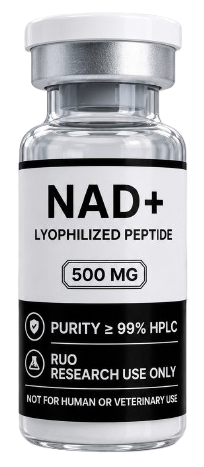
NAD+ (Nicotinamide Adenine Dinucleotide) is a naturally occurring coenzyme that is involved in basic biological processes. Scientists conduct research into NAD+ in molecular biology, cellular metabolism, biochemistry, and energy signaling research in order to gain insight into the role of NAD+ in biological systems.
Certificate of Analysis
Batch PA-0071 — 500mg
View COA
Research Grade Quality
Independently Tested
NAD+
$99.99
Size / Strength
HPLC Verified
COA Included
Fast Dispatch
Discreet Shipping
100% Quality Guarantee
Every batch of NAD+ is independently third-party tested. 30-day money-back guarantee — no questions asked.
Product Description
As an essential component in living things, NAD+ is involved in a wide array of biochemical reactions, which involve electron transfer, enzyme activity, and signaling pathways. There has been increasing interest in studying NAD+, given the complexity of the biological mechanisms.
At Peptides Australia, NAD+ 500mg/1000mg is available solely for scientific use only (RUO) laboratory reagent, meant for research purposes, analysis, and education. Each lot comes with quality documentation such as analytical data and lot-specific Certificates of Analysis (COA).
Research Highlights
- Independent Laboratory Tested
- Batch-Specific Certificate of Analysis
- Australia-Wide Dispatch
- Research Use Only
- Analytical Quality Documentation
What is NAD+?
NAD+ (Nicotinamide Adenine Dinucleotide) is a natural coenzyme that occurs in cells in a variety of biological systems. NAD+ is made up of two nucleotides bonded together and acts as a key substance in several biochemical reactions.
Contrary to peptides, NAD+ is considered a small molecule coenzyme and not a peptide compound. The reason why it is extensively researched in biochemical studies is due to its key function in cellular processes.
Scientists study NAD+ to learn about its role in:
- Cellular metabolism
- Redox reactions
- Enzyme activity
- Molecular signalling pathways
- Mitochondria
- Cellular communication
There are two primary forms of NAD+:
- Oxidized NAD+
- Reduced NADH
Conversion of NAD+ to NADH is one of the main biochemical processes that researchers study in molecular and cellular sciences.
Scientific Background
The discovery of NAD+ occurred as a result of biochemical investigation into fermentation mechanisms and has been since recognized as an important constituent of cellular chemistry.
NAD+ remains an area of active modern scientific inquiry due to its widespread presence in biological systems.
Research on NAD+ occurs in the following scientific fields:
- Biochemistry
- Molecular biology
- Cellular biology
- Pathway investigation
- Enzymatic investigations
Molecular Properties of NAD+
NAD+ is a pyridine nucleotide coenzyme that contains:
- Nicotinamide
- Adenine
- Ribose
- Phosphates
Due to its molecular structure, NAD+ can be involved in electron transfer and enzymatic reactions.
Molecular Structure and Function
The structure of NAD+ makes it capable of taking part in biochemical processes where there is electron transfer.
Studying NAD+ is important due to its involvement with:
- Oxidation-Reduction Processes
- Enzyme Action
- Cell Signalling
- Molecular Communication
Learning about the chemistry of NAD+ is useful in further studies of biochemical regulation in living organisms.
Lyophilised Powder Format
NAD+ research materials are often available as lyophilized powders.
Lyophilization is the controlled process of freezing and drying that helps to eliminate water and enhance stability in storage.
The advantages of lyophilized forms are:
- Reduced moisture content
- Consistent storage
- Improved lab documentation
- Controlled handling
It is necessary to adhere to the proper laboratory storage instructions when storing NAD+ materials.
Manufacturing Process Overview
Chemical Synthesis
NAD+ research materials are manufactured through controlled chemical manufacturing processes to ensure that the molecular compound is generated.
General workflow of production can be:
- Selection of raw materials
- Chemical synthesis
- Purification process
- Analytical testing
- Drying process
Documentation of batches
Each process ensures the production of uniform research materials for laboratory experiments.
Purification Process
The purification process is a critical component in preparing NAD+ research materials.
Through purification process, the intended compound is separated from:
- Unintended chemicals
- Reaction products
- Compounds related to the desired compound
- Impurities in the manufacturing process
Analytical testing after purification helps establish the characteristics of the product.
Research Use Only (RUO)
NAD+ 500mg/1000mg from Peptides Australia is available strictly as a Research Use Only (RUO) laboratory material.
This product is exclusively meant for use in:
- Scientific study
- Laboratory testing
- Educational study
- Experimentation
NAD+ available as a research compound is not approved in Australia for any therapeutic, diagnostic, veterinary or human use.
Distinguishing Research Materials and Approved Products
Research compounds and approved medicines serve different purposes.
An approved medicine goes through a regulatory process that involves:
- Evaluation of safety
- Clinical testing
- Manufacturing
- Approved uses
Research materials are provided to scientists for study and do not qualify as pharmaceuticals.
Conducting Research in the Laboratory Environment
Scientists and organizations dealing with RUO materials should make sure that the activities comply with:
- Policies of the institution regarding research
- Laboratory safety protocols
- Requirements for scientific oversight
- Australian regulations
Research materials for NAD+ should be used in appropriate laboratory settings.
Why Choose Peptides Australia?
Choosing trustworthy research compounds will require access to clear documentation, information, and supply standards.
Peptides Australia supplies NAD+ research compounds with clear documentation that includes:
- Universities
- Biotechnology companies
- Laboratory researchers
- Science organizations
Batch-Specific Certificate of Analysis
Batch-specific COAs supply researchers with information about specific products.
It will allow:
- Laboratory documentation
- Verification of materials
- Traceability in research
Independent Laboratory Testing
Analytical testing will give information about:
- Product identity
- Purity information
- Assessment of quality
Researchers can use documentation while evaluating laboratory materials.
Research Use Only
This product is intended solely for laboratory research purposes. Not for human consumption.
Storage & Handling
Storage Stability
The stability of NAD+ may depend on the surrounding conditions.
The factors taken into account by researchers usually include:
- Temperature conditions
- Control of moisture
- Light protection
- Packaging conditions
- Transport conditions
Proper storage documentation is one of the important aspects of responsible laboratory practice.
Some related educational resources for researchers may include:
- Peptide Purity Understanding
- Guidance for Certificate of Analysis
- Lab Storage Guidelines
Reasons Why Researchers Study NAD+
NAD+ has received much attention in scientific research because of its importance in basic cellular biochemistry.
Scientists are interested in discovering the mechanisms rather than creating applications.
Cellular Metabolism Research
Cellular metabolism is one of the main directions of NAD+ studies.
NAD+ acts as a coenzyme in metabolic processes where electron transfers take place.
Scientists study:
- Metabolic processes
- Enzyme interactions
- Energy processes in a cell
- Biochemical regulation
This type of research allows to uncover how cells cope with complex biochemical processes.
Redox Biology Research
NAD+ has an important part in redox biology.
Redox reactions mean electron transfer between molecules that is necessary for biochemical processes.
Researchers look at:
- NAD+/NADH conversion
- Processes of electron transfer
- Enzyme activity
- Balance of molecules in experimental conditions
Mitochondrial Biology Research
Mitochondria are cellular structures that participate in many biochemical processes.
Scientists study NAD+ in mitochondrial biology due to its connection with:
- Cellular metabolism
- Biochemical processes
- Molecular signaling
- Enzyme Interaction Studies
NAD+ functions as a cofactor for several enzymes.
NAD+ dependent enzyme investigations help researchers understand:
- Protein function
- Molecular interactions
- Regulation of cellular activities
These studies add value to general biochemical research.
Cell Signaling Studies
Apart from being used in metabolism, NAD+ is also investigated in cell signaling studies.
Researchers carry out investigations about NAD+ pathways related to:
- Molecular signals
- Enzymes
- Cell communication systems
Such studies provide insight into biological processes.
Cell Aging Research
NAD+ is now researched in aging cellular biology.
Researchers conduct studies involving NAD+ pathways in their larger studies about:
- Cell biology
- Molecular regulation
- Processes of aging
These studies are aimed at gaining insight into cellular biology and cannot be considered therapeutic applications.
Manufacture and Quality Controls
Manufacture of NAD+ research materials involves controlled manufacture, analysis, and documentation to facilitate laboratory evaluation.
While NAD+ is a coenzyme and not a peptide, manufacture of research grade NAD+ materials involves strict chemical synthesis, purification, and quality control.
At all stages of manufacturing, attention is paid to:
- Compound identity
- Chemical homogeneity
- Analysis quality
- Traceability of batches
These quality controls enable researchers to evaluate laboratory materials transparently.
Temperature Management
Researchers need to ensure that proper conditions for storage are followed which avoid unwanted environmental fluctuations.
These can include:
- Maintain proper storage conditions
- Avoiding temperature fluctuations
- Ensuring protection during shipment
Moisture Protection
Exposure to moisture may affect stability of a number of chemical compounds.
It may involve:
- Properly sealing containers
- Avoiding humidity exposure
- Following storage recommendations by suppliers
Light Protection
Researchers should consider protecting NAD+ materials from prolonged exposure to direct light.
Controlled storage environments help maintain consistent laboratory materials.
Laboratory Documentation
Common documentation kept in research facilities includes:
- Batch information
- Storage information
- Specifications
- Experimental data
Proper documentation helps with quality management in scientific settings.
For more information, researchers can consult the Peptide Storage Guidelines and other laboratory storage guidelines.
Full Technical Specifications
Every batch of NAD+ is independently analysed before dispatch. The values below describe the current research batch.
| Product Name | NAD+ |
|---|---|
| CAS Number | 53-84-9 |
| Molecular Formula | C₂₁H₂₇N₇O₁₄P₂ |
| Molecular Weight | 663.4 g/mol |
| Quantity / Strength | 500mg | 1000mg |
| Purity | ≥ 99% (HPLC) |
| Form | Lyophilised Powder |
| Appearance | White Lyophilised Powder |
| Batch Number | PA-0071 |
| Storage Conditions | 2°C-8°C (Refrigerated) |
| Category | Longevity & Anti-Aging |
| Intended Use | Research Use Only — not for human consumption |
Certificate of Analysis
Every batch of NAD+ is independently tested before dispatch. View the full COA for the current batch below.
Certificate of Analysis (COA)
Batch Number PA-0071
≥ 99%
Purity
HPLC
Confirmed
Identity
Mass Spec
Pass
Heavy Metals
ICP-MS
| COA Information | Purpose |
|---|---|
| Product Name | Confirms material identification |
| Batch Number | Supports traceability |
| Testing Results | Provides analytical information |
| Testing Method | Identifies analytical techniques |
| Purity Information | Shows quality assessment results |
| Quality Review | Documents evaluation process |
Quality Control and Batch Traceability
Research materials require proper documentation and quality control measures to ensure their reliability.
Batch documentation may include:
- Identification of the product
- Batch number
- Analysis results
- Quality assessment data
- Storage recommendations
Batch traceability enables researchers and institutions to maintain laboratory records.
Purity Testing and Analytical Verification
Analytical testing gives researchers crucial information regarding the characteristics of the research material.
Researchers examine the analytical documentation to determine:
- Compound identity
- Chemical purity
- Consistency of batches
- Quality specifications
High-Performance Liquid Chromatography (HPLC)
High Performance Liquid Chromatography (HPLC) is one of the most popular methods of analysis of chemicals.
HPLC separates the mixture and enables the researcher to analyze the obtained results by the chromatogram.
HPLC analysis of NAD+ can give information about:
- Purity of the compound
- Related compounds
- Composition of the sample
- Consistency of the batch
Analysis of samples via chromatography is widespread in pharmaceuticals, biotechnological and academic laboratories.
Mass Spectrometry Analysis
Mass spectrometry methods can be applied for the analysis of molecular properties of research compounds.
Mass spectrometry can give information about:
- Molecular mass
- Identity of the compound
- Structural properties
Combining mass spectrometry with chromatography gives more information about the sample.
Certificate of Analysis (COA)
A Certificate of Analysis (COA) is a batch-specific document that provides analytical information about a research material.
For NAD+ research products, a COA may include:
Reviewing a Certificate of Analysis helps researchers understand the characteristics of laboratory materials before beginning investigations.
Researchers can gain more information from education sources including:
- How To Read a Certificate of Analysis
- The Understanding Of Laboratory Testing
- Third-Party Laboratory Testing
- Storage and Laboratory Handling Information
Appropriate storage is essential for ensuring the stability of NAD+ research material.
NAD+ is provided as dried powder and needs to be handled following appropriate lab protocols.
Quality Documentation
Documentation makes it possible for researchers to conduct responsible research because it will provide information about:
- Product specifications
- Testing procedures
- Batch information
- Secure Packaging
Proper packaging is required to protect research compounds during transportation and storage.
Dispatch Across Australia
Proper supply allows access to:
- Research facilities
- Universities
- Biotechnology labs
- Scientific researchers
Researchers planning to purchase NAD+ in Australia should consider certificates of analysis and analytical documentation available from suppliers.
Research Disclaimer
For Research Use Only — Not for Human Consumption
This content is provided for educational, scientific and research-information purposes only. It does not provide medical advice, treatment recommendations or personal dosage instructions. Available evidence concerning NAD+ includes preclinical research and ongoing or completed clinical investigations. Further research is required to better understand its safety, pharmacology and potential efficacy for specific research applications.
- Not for human or veterinary use
- No claims are made regarding safety or efficacy in humans
- Must be handled with appropriate laboratory safety equipment
- Purchaser assumes all responsibility for legal, compliant use
References
5 sources- 1Verdin E. NAD⁺ in Aging, Metabolism, and Neurodegeneration. Science. 2015;350(6265):1208-1213.PubMed: https://pubmed.ncbi.nlm.nih.gov/26785480/
- 2Covarrubias AJ, Perrone R, Grozio A, Verdin E. NAD⁺ Metabolism and Its Roles in Cellular Processes During Ageing. Nature Reviews Molecular Cell Biology. 2021;22(2):119-141.PubMed: https://pubmed.ncbi.nlm.nih.gov/33067582/
- 3Katsyuba E, Romani M, Hofer D, Auwerx J. NAD⁺ Homeostasis in Health and Disease. Nature Metabolism. 2020;2(1):9-31.PubMed: https://pubmed.ncbi.nlm.nih.gov/32694684/
- 4Radenkovic D, Reason, Verdin E. Clinical Evidence for Targeting NAD Therapeutically. Pharmaceuticals. 2020;13(9):247. PubMed: https://pubmed.ncbi.nlm.nih.gov/32916850/PubMed: https://pubmed.ncbi.nlm.nih.gov/32916850/
- 5Australian Government, Therapeutic Goods Administration (TGA). NAD, NAD+, NADH or NMN Medicines Sold in Australia. Therapeutic Goods Administration. 7 April 2025.TGA: https://www.tga.gov.au/safety/safety-monitoring-and-information/safety-alerts/nad-nad-nadh-or-nmn-medicines-sold-australia
Citations are provided for research reference and open in a new tab. Listing a study does not imply it evaluated this specific product.
Frequently Asked Questions
Researchers Also Purchase


Why Researchers Choose Us
Research-Grade Quality. Trusted by Researchers Across Australia.
Learn About Our QualityDiscreet Packaging
Fast Australia-Wide Delivery
Expert Support
30-Day Money Back