
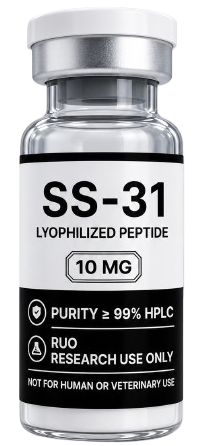
SS-31 is a research compound that is made up of a synthetic peptide. The SS-31 peptide is examined in mitochondrial biology and molecular science studies. Scientists study SS-31 as a model peptide to understand peptides and how they work with mitochondria and signalling pathways in cells.
Certificate of Analysis
Batch PA-0144 — 10mg
View COA
Research Grade Quality
Independently Tested
SS-31
$89.99
Size / Strength
HPLC Verified
COA Included
Fast Dispatch
Discreet Shipping
100% Quality Guarantee
Every batch of SS-31 is independently third-party tested. 30-day money-back guarantee — no questions asked.
SS-31 – Research Overview
The research on SS-31 peptide includes molecular characterisation, peptide chemistry, mitochondrial research models, and biochemical pathway research. This type of research helps scientists learn more about the way that peptides interact with cell parts.
Scientists examine the SS-31 peptide when conducting research into mitochondrial biology and molecules related to cells. Laboratory tests are done to examine the molecular properties and the way that peptides behave and interact.
SS-31 10mg is available at Peptides Australia only as a Research Use Only (RUO) laboratory product. All batches of SS-31 include analysis documentation, such as analytical data and Certificates of Analysis (COA).
Research Highlights
- Independent Laboratory Tested
- Batch-Specific Certificate of Analysis
- Australia-Wide Dispatch
- Research Use Only
- HPLC Tested Peptide Material
What is SS-31?
SS-31, which is referred to in scientific literature as elamipretide, is a tetrapeptide that has been synthesized and used for research in mitochondrial and cellular biology.
SS-31 was created in laboratories as a research peptide that was to be used to study the effects of artificial peptide molecules on mitochondria.
Scientists research SS-31 in order to learn more about:
- Peptide molecular characteristics
- Mitochondrial research pathways
- Cellular signaling pathways
- Biological interactions
Just like other research peptides, SS-31 is studied in laboratories and is neither an approved consumer good nor a medicinal drug in Australia.
Scientific Background of SS-31 Research
The modern approach to peptides research includes chemical and biotechnological research of small amino acid chains interaction within biological organisms.
Scientists study peptides due to the fact that their molecular structures affect:
- Chemical properties
- Stability features
- Molecular interactions
- Analytical profiles
Artificial peptide models provide scientists with an opportunity to study particular molecular characteristics without complications of the whole biological organism.
SS-31 is a specialized peptide research compound studied in mitochondrial science.
Mitochondrial Peptide Research Background
Mitochondria are structures that are studied extensively in the discipline of molecular biology due to their importance in cellular functions.
Research into mitochondrial biology is carried out to study:
- Cell organization
- Molecular pathways
- Interactions between proteins and peptides
- Biochemical reactions
SS-31 is researched in this area as a model synthetic peptide that is used for studying molecular interactions in mitochondria.
Classification of Peptides
SS-31 is classified as a tetrapeptide research compound.
Peptides are small peptide chains made from amino acids by peptide bonds.
Their properties depend on:
- Amino acid sequence
- Molecular structure
- Chemical modification
- Environmental factors
Such properties are studied in the laboratory using chromatography and mass spectrometry.
Molecular Characteristics of SS-31
Understanding molecular characteristics is an important part of peptide research.
SS-31 has a defined amino acid sequence that researchers evaluate through analytical methods.
Stability Considerations
The stability of peptides can depend on the environment conditions.
Scientists usually pay attention to such aspects as:
- Temperature exposure
- Amount of moisture
- Light exposure
- Packaging conditions
- Period of time of storage
Proper storage conditions help preserve the characteristics of research substance.
Why Researchers Study SS-31
The scientific interest in SS-31 peptide lies in its role as a peptide model in mitochondrial and cellular biology research.
Laboratory research deals with learning about the molecular mechanism and not about any possible clinical application.
Mitochondrial Biology Research
The scientific research of mitochondrial biology involves studies on:
- Cellular structures
- Molecular pathways
- Biochemical processes
- Energy-related cellular mechanisms
Scientists conduct research on mitochondrial systems to learn more about interactions and communication between cellular structures.
SS-31 is researched in the context of mitochondrial biology as a molecular research tool.
Cellular Pathway Research
Cells depend on elaborate networks of proteins, peptides, enzymes, and signalling molecules.
Scientists study these pathways to learn about:
- Molecular communication
- Cellular organization
- Biochemical interactions
- Structural relationships
Synthetic peptides like SS-31 offer scientists a molecular model for laboratory research.
Oxidative Stress & Molecular Signalling Research
Oxidative stress and molecular signaling pathways represent the extensively researched areas of cellular biology.
Scientists research these fields to learn about:
- Molecular interactions
- Cellular responses
- Biochemical pathways
- Regulatory mechanisms
Research on SS-31 belongs to scientific research of peptide interactions in these laboratory models.
Experimental Research Models
The study of SS-31 can take place through various laboratory methods that include:
- Analytical chemistry
- Molecular characterization
- Cellular models
- Biochemistry analysis
This study aims to help in building up scientific knowledge about peptide chemistry and mitochondria.
Manufacturing & Quality Control
A reliable peptide for research needs to go through controlled manufacturing process, analysis, and documentation.
SS-31 10mg is manufactured as a research peptide by way of using controlled peptide chemistry methods in order to achieve consistency and laboratory testing.
A quality-controlled peptide manufacturing includes several key steps, which are:
- Sequence Preparation
- Synthesis
- Purification
- Analysis
- Lyophilization
- Documentation
Such an approach gives researchers necessary data about the identity and composition of the laboratory peptides.
Solid Phase Peptide Synthesis (SPPS)
Peptide synthesis generally involves Solid Phase Peptide Synthesis (SPPS), a proven technique that is widely used in peptide chemistry and biotechnology.
SPPS allows scientists and producers to combine amino acids in a controlled manner and thereby build up a definite peptide structure.
Production steps include:
- Choice and preparation of peptide sequence
- Controlled amino acid coupling
- Rinsing away synthesis support materials
- Peptide purification
- Analytical work
- Freezing and preparing
- Production documentation and release of batch
This procedure allows producing defined peptide materials for research.
Peptide Purification Process
After the synthesis procedure, there comes the purification step allowing isolation of the desired peptide from all unnecessary substances formed during synthesis.
Purification procedures allow eliminating:
- Incomplete peptide sequences
- Synthesis materials
- Peptides related to the synthesized one
- Manufacturing contaminants
Controlled purification process allows achieving higher analytical accuracy.
Lyophilisation Process
Following purification and analysis, SS-31 is provided in lyophilised powder form.
Lyophilisation is a freeze-drying process that is often employed for research peptides.
Lyophilisation decreases the amount of moisture in research peptide while stabilising the product.
Advantages of using lyophilised research peptides include:
- Lower moisture exposure
- Better storage conditions
- Ease of laboratory manipulation
- Controlled documentation
Appropriate laboratory procedures should be followed when handling lyophilised peptides by researchers.
Research Use Only (RUO)
SS-31 10mg manufactured by Peptides Australia is supplied exclusively as Research Use Only (RUO) laboratory reagent.
The material is intended for:
- Scientific studies
- Lab analysis
- Educational research
- Controlled experiments
SS-31 peptide is not permitted for any therapeutic, diagnostic, veterinary or human use in Australia.
Research Reagents and Approved Medications
Research peptides and approved medicines have distinct purposes.
Medicines are regulated through:
- Safety tests
- Clinical trials
- Production control
- Medical use approvals
Research peptides are supplied for laboratory research and are not the same as approved medicines.
Conducting Responsible Lab Research
Researchers and organizations which use RUO materials are responsible for:
- Meeting institutional guidelines
- Laboratory safety protocols
- Research conduct requirements
- Australian regulations
SS-31 is to be used only under laboratory conditions.
Why Choose Peptides Australia?
Effective research into peptides requires the availability of clear documentation, quality information and lab materials.
Peptides Australia provides documentation that is helpful in:
- Universities
- Biotechnological companies
- Research labs
- Science institutions
Research Use Only
This product is intended solely for laboratory research purposes. Not for human consumption.
SS-31 – Storage & Handling
Storage & Laboratory Handling Procedures
Proper handling and storage are necessary in order to maintain the quality of peptide research materials.
SS-31 comes in the form of lyophilized powder and should be handled in accordance with appropriate laboratory procedures.
Temperature
Researchers should pay attention to proper storage conditions that avoid unneeded temperature changes.
These include:
- Keeping storage conditions as required
- Avoiding any changes in temperatures
- Protection during transportation
Moisture Protection
Lyophilized peptides require proper protection from too much moisture.
Appropriate laboratory practices include:
- Sealing containers properly
- Prevention of exposure to high humidity
- Storage conditions as recommended by suppliers
Light Protection
Peptide materials should be protected from direct light exposure for a long period of time.
Controlled storage conditions help preserve characteristics of research material.
Laboratory Documentation
Commonly scientific facilities have documents that include:
- Batch data
- Storage information
- Product specifications
- Research procedures
Documenting is an important part of laboratory quality management.
One may look into such topics as:
- Peptide Storage Recommendations
- Reading a Certificate of Analysis
- Laboratory Quality Control
SS-31 – Technical Specifications
Every batch of SS-31 is independently analysed before dispatch. The values below describe the current research batch.
| Product Name | SS-31 |
|---|---|
| CAS Number | 736992-21-5 |
| Molecular Formula | C₃₂H₄₉N₉O₅ |
| Molecular Weight | 639.8 g/mol |
| Quantity / Strength | 10mg |
| Purity | ≥ 99% (HPLC) |
| Form | Lyophilised Powder |
| Appearance | White Lyophilised Powder |
| Sequence | D-Arg–Dmt–Lys–Phe-NH₂ |
| Batch Number | PA-0144 |
| Storage Conditions | 2°C-8°C (Refrigerated) |
| Category | Longevity & Anti-Aging |
| Intended Use | Research Use Only — not for human consumption |
SS-31 – Certificate of Analysis
Every batch of SS-31 is independently tested before dispatch. View the full COA for the current batch below.
Certificate of Analysis (COA)
Batch Number PA-0144
≥ 99%
Purity
HPLC
Confirmed
Identity
Mass Spec
Pass
Heavy Metals
ICP-MS
| COA Information | Purpose |
|---|---|
| Product Name | Confirms peptide identification |
| Batch Number | Supports traceability |
| Purity Results | Provides analytical evaluation |
| Testing Method | Identifies analytical techniques |
| Identity Testing | Supports molecular confirmation |
| Quality Review | Documents assessment |
Batch Traceability and Quality Documentation
Batch traceability is a necessary component in the provision of research peptides.
Documentation regarding SS-31 may include:
- Product identity
- Batch number
- Analytical testing data
- Quality specifications
- Storage conditions
By maintaining accurate documentation, research institutions, universities, and biotechnology companies can document their laboratory materials during research.
Purity Testing & Certificate of Analysis (COA)
Through analytical testing, researchers gain information about peptide identity, purity, and quality specification. Prior to choosing laboratory peptides, researchers tend to examine:
- Analytical testing data
- Purity information
- Identity information
- Batch documentation
High-Performance Liquid Chromatography (HPLC)
High-performance liquid chromatography (HPLC) is one of the most frequently employed analytical techniques for assessing the purity of peptides.
The HPLC technique allows for separation of components in a sample and produces a chromatogram that can be analyzed for purity parameters.
In case of SS-31 research materials, HPLC testing can allow to determine:
- Purity percentage
- Composition of the sample
- Impurities
- Consistency of batches
HPLC testing is a popular method of analysis in peptide chemistry, biotechnology, pharmaceutical research, and academia.
Analytical techniques of interest include:
- Understanding Peptide Purity
- HPLC vs LC-MS Testing
- Third-Party Laboratory Testing
LC-MS Identity Testing
Liquid Chromatography-Mass Spectrometry (LC-MS) is frequently employed for peptide identity verification.
LC-MS allows scientists to assess such properties as:
- Peptide molecular weight
- Predicted identity of the peptide
- Structural parameters
Combining different analytical techniques gives more information on laboratory peptides.
Certificate of Analysis Explained
Certificate of Analysis (COA) is a specific for each batch document containing analytical data on research peptide.
A typical COA may include:
COA allows researchers to examine laboratory material specifications prior to undertaking scientific investigations.
For researchers considering the purchase of SS-31 in Australia, the following COA documents, analysis test results, and supplier’s quality standards should be considered before selection of research peptides.
Certificate of Analysis per Batch
These certificates give analytical information related to each batch of products.
It helps in:
- Documenting laboratories
- Verifying materials
- Research tracking
- Testing from Independent Laboratories
Analytical testing gives researchers information related to:
- Identification of peptides
- Characteristics of purity
HPLC Tested Peptides
HPLC testing gives analytical information on purity and composition of peptides.
It enables researchers to get the testing documentation when assessing lab peptides.
Packaging
Effective packaging protects research lyophilised materials while transporting and storing them.
Australia-Wide Dispatch
The dispatch is useful in accessing materials for:
- Research institutions
- Universities
- Biotechnological companies
- Science laboratories
Researchers interested in buying SS-31 from Australia should consider specifications, certificate of analysis, analytical information and Research Use Only classification.
Research Disclaimer
For Research Use Only — Not for Human Consumption
This content is provided for educational, scientific and research-information purposes only. It does not provide medical advice, treatment recommendations or personal dosage instructions. Available evidence concerning SS-31 includes preclinical research and ongoing or completed clinical investigations. Further research is required to better understand its safety, pharmacology and potential efficacy for specific research applications.
- Not for human or veterinary use
- No claims are made regarding safety or efficacy in humans
- Must be handled with appropriate laboratory safety equipment
- Purchaser assumes all responsibility for legal, compliant use
References
5 sources- 1Szeto HH. First-in-Class Cardiolipin-Protective Compound as a Therapeutic Agent to Restore Mitochondrial Bioenergetics. British Journal of Pharmacology. 2014;171(8):2029-2050. PubMed: https://pubmed.ncbi.nlm.nih.gov/24117165/PubMed: https://pubmed.ncbi.nlm.nih.gov/24117165/
- 2Birk AV, Chao WM, Bracken C, Warren JD, Szeto HH. Targeting Mitochondrial Cardiolipin and the Cytochrome c/Cardiolipin Complex to Promote Electron Transport and Optimize Mitochondrial ATP Synthesis. British Journal of Pharmacology. 2014;171(8):2017-2028.PubMed Central: https://pmc.ncbi.nlm.nih.gov/articles/PMC3976619/
- 3Birk AV, Liu S, Soong Y, et al. The Mitochondrial-Targeted Compound SS-31 Re-Energizes Ischemic Mitochondria by Interacting with Cardiolipin. Journal of the American Society of Nephrology. 2013;24(8):1250-1261.PubMed: https://pubmed.ncbi.nlm.nih.gov/23813215/
- 4Karaa A, Haas R, Goldstein A, Vockley J, Weaver WD, Cohen BH. Randomized Dose-Escalation Trial of Elamipretide in Adults with Primary Mitochondrial Myopathy. Neurology. 2018;90(14):e1212-e1221. PubMed: https://pubmed.ncbi.nlm.nih.gov/29500292/PubMed: https://pubmed.ncbi.nlm.nih.gov/29500292/
- 5Australian Government, Department of Health, Disability and Ageing. Concerns Regarding the Public Health Risks Associated with Unapproved Peptide Products. Australian Government. 19 June 2026. Australian Government:health.gov.au: https://www.health.gov.au/news/concerns-regarding-the-public-health-risks-associated-with-unapproved-peptide-products?language=en
Citations are provided for research reference and open in a new tab. Listing a study does not imply it evaluated this specific product.
SS-31 – Frequently Asked Questions
Researchers Also Purchase


Why Researchers Choose Us
Research-Grade Quality. Trusted by Researchers Across Australia.
Learn About Our QualityDiscreet Packaging
Fast Australia-Wide Delivery
Expert Support
30-Day Money Back